
How to Build an Artist Grant Budget
Build an artist grant budget by applying the funder’s rules to the project scope, then listing eligible project expenses with traceable calculations and recording the permitted funding sources that will cover them. Set the grant request from the remaining eligible need after other applicable funding or contributions, subject to any minimum or maximum award, match, cost-share, timing, and format rules; an arithmetically balanced budget reconciles its funding and expense totals, but pending funding is not confirmed funding.

Artist grant budget: decision model
Use this order so each amount stays connected to both the project and the grant’s rules.
- Verify the grant rulesConfirm eligible and excluded costs, the funding period, award limits, match or cost-share rules, permitted contribution types, and the required budget format.
- Define the project scopeList the activities, labour, materials, spaces, travel, access needs, and timing that create legitimate project costs.
- Price eligible expensesFor each line item, connect quantity or time to a defensible rate or unit cost, then total the eligible project expenses.
- Record the funding sideShow other project income or cash contributions by status. Include in-kind support only when the funder permits its use and valuation, and treat the grant request as one funding source.
- Set and reconcile the requestThe remaining eligible need is the part of eligible project cost not covered by applicable other funding or contributions. Keep the request within program limits and conditions, then check that the budget totals reconcile in the funder’s required format.
Key distinction: a balanced budget shows arithmetic reconciliation; it does not make pending income confirmed, prove that every cost is eligible, or guarantee that the project is fully financed.
Table of Contents
Start With the Grant's Budget Requirements and Project Scope
Verify the grant budget requirements and define the project scope before entering any costs.
The grant guidelines determine the budget format and other constraints the proposed project must follow, while the project scope defines the activities and resources that may need funding.
A necessary project cost is not automatically an eligible cost; the funder’s rules determine whether that expense can appear in the funding request.

Check the required budget format, the funding period covered by the grant, and any award limit stated in the grant guidelines.
Confirm which expenses are eligible costs and which are excluded costs or subject to category restrictions.
If the program has a match requirement or cost-share rule, verify the required contribution and documentation rather than assuming a standard percentage.
Confirm separately whether in-kind support can count toward the match requirement or project funding and how the funder requires it to be valued or recorded.
Turn the verified funder rules and project scope into planning checks before estimating costs.
Use these checks to verify which project activities, costs, contributions, and amounts the grant permits.
- Confirm the required budget format and any mandatory categories.
- Identify the funding period and check which project activities fall within it.
- Record the stated award limit or other funding-request constraint.
- Separate eligible costs from excluded costs and note any category restrictions.
- Verify any match requirement or cost-share condition and its documentation requirements.
- Confirm whether in-kind support is accepted and how it must be recorded.
- Check that each planned cost relates to the defined project scope and satisfies the applicable grant guidelines.
Identify Funding Limits, Eligible Costs, and Match Requirements
Budget eligibility criteria determine what an artist can request, which costs can be counted, and whether matching contributions are required.
A funding limit may set a minimum request, maximum request, or other funding cap, while eligible expense rules, category caps, and matching requirements control what can appear in the budget.
The applicable amounts, percentages, and contribution rules must come from the specific grant instructions; no universal threshold is established for artist grants.

Map each grant rule to the budget decision it changes.
This keeps the criterion, the condition that must be confirmed, and its practical budget implication together without assuming that a rule from another funding program applies.
| Criterion | Condition to confirm | Budget implication |
|---|---|---|
| Funding limit | Any stated minimum request, maximum request, or funding cap | Sets the permitted boundary for the request amount. |
| Cost eligibility | Which costs are an eligible expense or an ineligible expense | Determines which project costs may be charged to the grant. |
| Category cap | Whether the funder limits spending within a particular cost category | Restricts the amount that may be assigned to that category. |
| Cash match | Whether a cash contribution is required or permitted and what amount or percentage must be documented | Determines whether documented cash may count toward the matching requirement. |
| In-kind match | Whether non-cash contributions may count and how they must be valued and documented | Determines whether qualifying goods, services, or other non-cash support may count toward the match. |
| Cost share | Any required share or percentage stated by the specific program | Determines the portion of project costs that must come from sources identified by the program rules. |
Cash match is a monetary contribution, while an in-kind match is a qualifying non-cash contribution when the program permits it.
Treat either contribution as countable only when the grant instructions specify that form of match and its valuation or documentation requirements.
Build the Budget From Project Expenses and Income
A project budget has two connected sides: project expenses show what the proposed project will cost, while project income and other funding sources show how those costs will be funded.
The grant request belongs on the funding side as one source of project funding rather than as the entire budget.
Together, the expense side and funding side describe the financial structure of the proposed project.
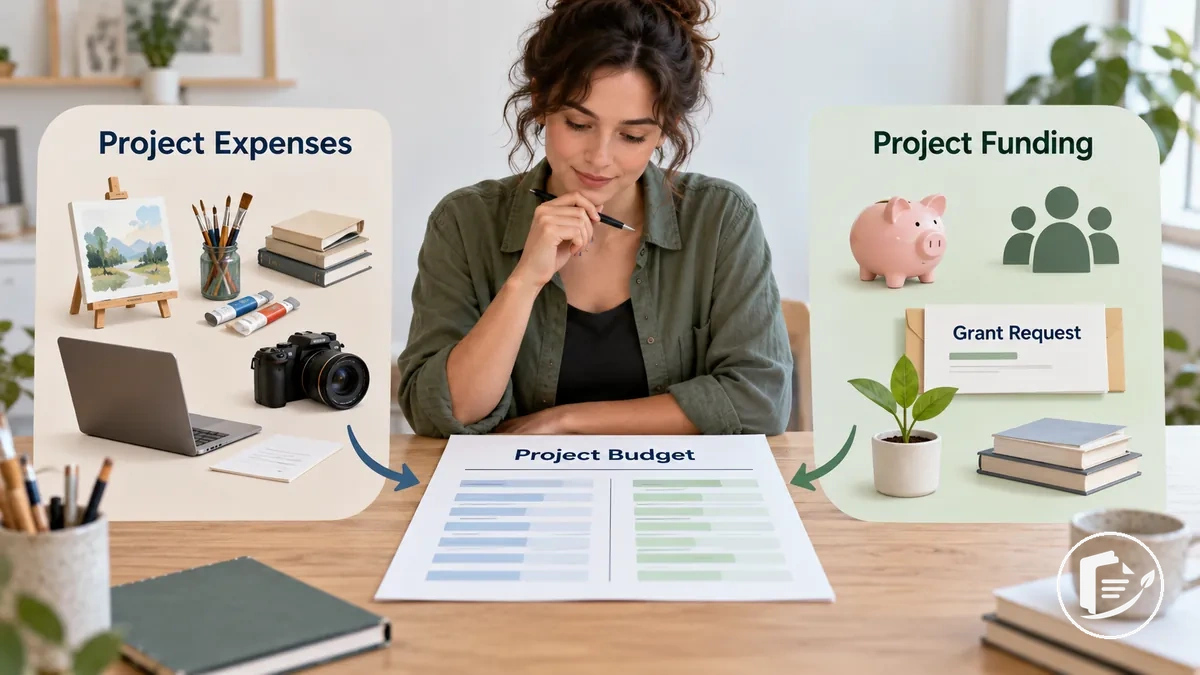
The structure below separates the components by their role in the project budget and shows how each relates to total project cost.
Project expenses combine into the total project cost, while project income, the grant request, and relevant contributions contribute to the funding available to cover that cost.
A cash contribution belongs on the funding side when it is part of the project's permitted funding structure.
In-kind support should be recorded only when the funder's definitions allow it to be included, and it should not be treated as cash income unless the funder explicitly defines it that way.
| Budget component | Role in the project budget | Relationship to the whole |
|---|---|---|
| Project expenses | Records the costs attributable to project activities. | Combines into the total project cost. |
| Project income and funding sources | Records the funding expected or available for the project. | Contributes to covering the total project cost. |
| Grant request | Records the amount requested from the specific funder. | Forms one part of project funding rather than the whole budget. |
| Cash contribution | Records a monetary contribution where relevant to the project and permitted by the funder. | Adds to the funding available to cover project expenses. |
| In-kind support | Records qualifying non-cash support when the funder permits it. | Contributes to the budget only according to the funder's definition and valuation rules. |
Comparing total project cost with the funding side shows whether the budget is fully covered, partially covered, or still contains a funding gap.
Equal expense and funding totals show an arithmetically balanced budget, but they do not establish that pending funding is confirmed or that the project is guaranteed to be financed.
List Eligible Project Expenses in Clear Budget Categories
Eligible project expenses should be grouped into clear budget categories only when they relate to the proposed project and the grant allows them.
Each line item should identify its project purpose and have a calculation basis, such as hours multiplied by a rate or quantity multiplied by unit cost, rather than an unsupported round amount.
Category names do not establish eligibility by themselves.

The useful categories depend on the activities and resources required by the project.
Artist fees may relate to creative labour and use hours and a rate as the calculation basis; materials may relate to making the work and use quantities and unit costs.
Equipment or rental and venue or production costs may cover resources or spaces needed to deliver the work, while travel may relate to project-specific journeys.
Marketing or documentation may relate to communicating or recording the project, and accessibility costs may relate to access requirements; each category should be included only when relevant to the project and allowable under the grant.
- Artist fees: connect the fee to the creative or project labour it covers and state the basis used to estimate the amount, such as hours and a rate.
- Materials: connect supplies to the work being produced and calculate the line item from a defined quantity and unit cost where applicable.
- Equipment or rental: identify the equipment required for a project activity and base the estimate on the relevant purchase or rental basis when that cost is eligible.
- Venue or production costs: connect the cost to the space, production service, or delivery requirement it supports and state the basis of the estimate.
- Travel: identify the project activity requiring travel and use the applicable trip, fare, distance, accommodation, or other permitted calculation basis.
- Marketing or documentation: connect the expense to project communication or documentation and identify the service, quantity, or other basis used for the estimate.
- Accessibility: connect the expense to a specific access requirement and record the service, resource, or other permitted basis used to calculate it.
For a hypothetical materials line item, 8 units at $25 per unit produce an estimated cost of $200.
The arithmetic explains the calculation basis only; it does not establish that the materials or the example amount are eligible under a particular grant.
Record Project Income, Contributions, and In-Kind Support
Project income and contributions record the funding sources used to support the project rather than the costs of delivering it.
A cash contribution is recorded as money committed or available to the project, while in-kind support is a non-cash contribution such as eligible goods or services.
When the application requires funding status, each funding source should also be identified as confirmed or pending rather than treating expected support as secured.

The funding record should distinguish each funding source by form, status, and amount or value so the project funding total is transparent.
Project income may include relevant earned income, other grants, donations, sponsorships, the grant request, and cash contributions from the artist or project partners where the funder permits them.
Confirmed funding records support already secured under the applicable documentation requirements, while pending funding remains conditional on a future decision or commitment.
In-kind support may be included only when the funder's rules permit that form of contribution and provide or accept an appropriate valuation and documentation method.
The table separates these characteristics so each source's budget implication remains clear.
| Funding source | Form / status | Amount or value | Budget implication |
|---|---|---|---|
| Grant request | Cash / requested | Amount requested from the funder | Forms part of the project funding plan but is not confirmed funding unless awarded. |
| Other grant | Cash / confirmed or pending | Amount supported by the relevant grant documentation | Adds to project funding according to its stated status. |
| Donation or sponsorship | Cash / confirmed or pending | Amount committed or sought for the project | Contributes to project funding when the source is relevant and permitted to be recorded. |
| Artist or partner cash contribution | Cash / confirmed where committed | Amount committed to the project | Adds monetary support to the project funding total. |
| In-kind support | Non-cash / confirmed or pending | Value determined using a method permitted or accepted by the funder | May count toward project funding or match only when the program allows it. |
A cash contribution has a monetary amount, while in-kind support requires a non-cash valuation when the grant permits it to be counted.
Do not assign an arbitrary value to donated goods, services, or other support merely to make the budget balance; record the value only under the funder's applicable eligibility, valuation, and documentation rules.
Estimate Costs and Set the Grant Amount to Request
The grant request amount should come from realistic eligible project costs and the funding still needed under the program’s rules, not from an arbitrary target. The maximum award is a funding boundary, not automatically the amount to request.
- Remaining eligible need
- Start with total eligible project cost and account for the other applicable funding or contributions that will cover those costs. The uncovered amount is the remaining eligible need.
- Program boundaries
- The request must comply with any minimum or maximum award, funding cap, match or cost-share requirement, and other stated request conditions.
- Funding status
- If the funder distinguishes confirmed and pending support, present and calculate each source as instructed rather than treating expected support as secured.
Keep legitimate project costs based on documented project requirements rather than reducing them solely to produce a smaller request, and verify that the final request does not exceed the remaining eligible need or the applicable program limits.
Calculate Realistic Amounts for Each Line Item
Each line-item estimate should show how a defined quantity or time and a reasonable unit rate produce the line total.
Use hours, days, units, or another relevant measure, then support the rate or unit cost with a quotation, market check, prior documented cost, or another defensible source.
The result should be traceable rather than an arbitrary round number.
Use the same sequence for each estimate so the calculation basis is clear and can be verified before the line total is accepted.
- Identify the item: define the specific good, service, labour activity, rental, or other project cost represented by the line item.
- Determine quantity or time: record the required quantity, hours, days, or other measurable input based on the planned project activity.
- Establish a defensible rate: use a relevant quotation, market check, supplier information, contractor rate, or other evidence available for the location and timing of the project. Include taxes or fees only when applicable to the cost and permitted by the grant.
- Calculate the line total: multiply the quantity or time by the supported unit cost or rate; for example, an artist-fee line item can be calculated as documented hours multiplied by the evidenced hourly rate.
- Document the assumption: record the source of the estimate and any uncertainty affecting the amount. A contingency should appear only when the funder permits it and the basis for that contingency can be explained.
When an exact cost is not yet known, use the best supported estimate available and state the assumption rather than implying false precision.
Keep the quantity, rate or unit cost, line total, and supporting evidence connected so the estimate remains traceable.
Set the Requested Amount From Project Need and Funding Limits
The requested grant amount should reflect the unfunded eligible need after other funding and required contributions are accounted for, while remaining within the grant's program rules.
The amount requested must comply with any minimum award, maximum award, match requirement, or other stated funding condition rather than being based on an arbitrary target.
Evaluate the main criteria together because each one can change the final funding request.
- Total eligible costs: establish the total eligible costs before determining the remaining need that the requested grant amount may cover.
- Other funding: account for secured or otherwise credible other funding that will cover eligible costs, because this reduces the unfunded eligible need.
- Applicant contribution: include any required applicant contribution, cost share, or match requirement according to the program rules and the forms of contribution the funder permits.
- Award limits: compare the remaining eligible need with any minimum award, maximum award, or funding cap stated by the funder. The requested grant amount must remain within those applicable limits.
- Partial funding: assess whether the project remains viable if partial funding is awarded. If a smaller award requires a change in project scope, other funding, or the applicant contribution, the funding plan should reflect that condition.
If another funding source becomes confirmed, the unfunded eligible need may decrease and the request amount may need to decrease accordingly.
If a match requirement changes the required applicant contribution, recalculate the remaining eligible need under that condition before finalising the requested grant amount.
Keep the Budget Consistent With the Project Description and Timeline
Budget consistency means every material budget line should correspond to a project activity described elsewhere in the application and, where timing matters, to a plausible point in the project timeline.
The resource or labour being funded, its quantity, and its amount should support the same project scope rather than conflict with it.
This is a document-alignment check, not a funding match requirement.
Cross-check each project activity against the resource or labour it requires, then verify the relevant timing or quantity, the corresponding budget line, and the amount.
A promised activity should have the material costs needed to carry it out, while an unexplained cost should have a clear relationship to the stated work.
Use this sequence to connect the budget to the project description without rewriting the description itself.
Check budget consistency through the following relationships.
- Project activity: identify the stated activity that the material cost supports.
- Resource or labour: verify that the budgeted resource or labour is required for that activity.
- Timing or quantity: check that the stated quantity, hours, days, or other measure is consistent with the activity's scale and schedule.
- Budget line and amount: confirm that the budget line represents the required cost and that its amount corresponds to the stated resource, labour, timing, or quantity.
- Project period: verify that a cost tied to a scheduled activity falls within the eligible project period specified by the grant.
A mismatch exists when the project description promises an activity but a required cost is missing, or when a budgeted quantity conflicts with the stated duration.
A cost scheduled outside the eligible project period also needs correction or clarification under the funder's rules.
Use the same cross-check to align costs with the project timeline and correct inconsistencies in timing or quantity.
Recheck the affected budget line whenever the project activity, schedule, or required resource changes.
Explain Necessary Costs in the Budget Narrative When Required
A budget narrative is the written explanation of significant or non-obvious line items when the funder requires budget justification.
Its core job is to explain what each relevant line item covers, how the amount was calculated, and why the cost is necessary for the proposed project.
It adds financial context to the numerical budget rather than restating the entire proposal.
- Cost purpose
- What the line item covers and which project activity or resource it supports.
- Calculation basis
- The quantity, hours, days, rate, unit cost, or other basis that produces the budgeted amount.
- Source of estimate
- A quotation, market check, prior documented cost, or other defensible source when one is available.
- Necessity and conditions
- Why the cost is needed for the project and any assumption, restriction, contribution, or uncertainty that materially affects the amount.
The explanation should connect the cost to its project function and calculation without adding unsupported persuasive claims.
A vague justification such as “Studio hire is needed for the project” identifies a cost but does not show how the amount was derived.
A more specific hypothetical explanation is “Studio hire covers three project sessions; the budgeted amount is based on three days multiplied by the documented daily rate from the venue quotation”, which connects purpose, quantity, rate, source of estimate, and calculation basis without inventing a rate.
Broader guidance on how to write an art grant proposal belongs outside the budget justification; here, the required detail is the financial explanation of the line item.
Example of an Artist Grant Budget
This hypothetical artist grant budget example shows a visual artist budgeting for a small exhibition project with project expenses funded by a grant request and an artist contribution.
The illustrative figures demonstrate how costs, calculation bases, funding sources, and the total relate within one project; they are not recommended amounts or a universal budget format. Use the currency and formatting required by the funder in a real application.
Read the worked budget by comparing the project expenses with the project income and contribution entries that fund them.
Selected expenses show a calculation basis so the artist fee and materials can be traced to hours, rates, quantities, or unit costs.
The grant request represents one funding source, while the artist contribution covers the remaining amount.
In this hypothetical example, the funding total equals the expense total.
| Type | Line item | Calculation basis | Amount |
|---|---|---|---|
| Project expense | Artist fee | 30 hours × $50 per hour | $1,500 |
| Project expense | Materials | 10 units × $40 per unit | $400 |
| Project expense | Studio rental | 4 days × $150 per day | $600 |
| Project expense | Documentation | Illustrative quoted project cost | $500 |
| Project expenses | Total | Sum of expense lines | $3,000 |
| Project income | Grant request | Amount requested from the hypothetical funder | $2,500 |
| Project income | Artist contribution | Illustrative cash contribution | $500 |
| Project income | Funding total | Grant request + contribution | $3,000 |
The example shows an expense total of $3,000 funded by a $2,500 grant request and a $500 contribution, producing an internally balanced illustrative budget.
The artist fee and materials also show how a calculation basis connects a line item to its total rather than presenting an unexplained amount.
In a real application, eligible costs, categories, rates, funding caps, contribution treatment, match rules, and required budget format vary according to the specific grant, so the applicable funder rules determine the final entries.
Review Common Artist Grant Budget Mistakes
Artist grant budget mistakes can reduce financial accuracy, compliance, clarity, or credibility, but a single error does not by itself guarantee rejection.
Review the budget for objective mathematical errors, funder-rule conflicts, unsupported estimates, incorrect funding classifications, and inconsistencies with the proposed project.
Each mistake should be checked by identifying the problem it creates, the cue that reveals it, and the correction required.
The most useful review groups budget errors by calculation accuracy, rule compliance, funding classification, and project consistency.
Check totals and formulas for contradictions, compare every potentially ineligible expense with the funder rules, and verify that each unsupported estimate or inflated budget amount has a defensible calculation basis.
Confirm that every necessary project cost is represented, that a cash contribution is not confused with in-kind support, and that any match calculation follows the program's permitted contribution rules.
Large or unusual costs should have an identifiable purpose and basis, while each budget line should remain consistent with the related project activity and timing.
| Mistake | Consequence | Recognition cue | Corrective direction |
|---|---|---|---|
| Mathematical error | Creates an incorrect subtotal, total, or funding balance. | Line items do not add to the stated total or expense and funding totals contradict the intended budget structure. | Recalculate each line, subtotal, and total from the underlying figures. |
| Ineligible expense | May make part of the request non-compliant with the funder's rules. | A budget line falls outside the grant's stated eligible-cost conditions. | Remove, reclassify, or fund the cost elsewhere according to the applicable rules. |
| Unsupported estimate or inflated budget amount | Obscures how the amount was derived and may reduce credibility. | A large or rounded amount has no quotation, market check, rate, quantity, or other calculation basis. | Replace the unsupported estimate with a documented calculation or a clearly stated assumption. |
| Omitted cost | Leaves a promised project activity without the resource or labour needed to deliver it. | The project description includes an activity but no corresponding necessary budget line appears. | Add the necessary cost when eligible or explain how that activity will otherwise be resourced. |
| Cash contribution and in-kind support misclassified | Misstates the form of project funding and can affect contribution reporting. | A non-cash good or service is recorded as money, or a monetary contribution is recorded as in-kind support. | Classify each contribution by its actual form and apply the funder's valuation and documentation rules. |
| Incorrect match calculation | May leave the budget short of a required contribution or count support the program does not permit. | The required match does not reconcile with the stated contribution, or an ineligible contribution is included in the match calculation. | Recalculate the match using the program's stated percentage, calculation basis, and permitted contribution types. |
| Unexplained line item | Reduces clarity about what a significant cost covers and why it is needed. | A large or unusual budget line has no identifiable project purpose or calculation basis. | Add a concise justification that connects the line item to its purpose, amount, and supporting estimate. |
| Project mismatch | Creates inconsistency between the financial plan and the proposed activities or timing. | A quantity conflicts with the stated duration, a cost has no corresponding project activity, or an item falls outside the applicable project period. | Correct the budget line, quantity, timing, or project documentation so the records are consistent. |
Before submission, verify the arithmetic, confirm that each expense and contribution follows the applicable funder rules, and check that every assumption has a traceable basis.
Then compare the budget with the project description and schedule so unexplained costs, omitted costs, and timing mismatches are corrected.
Use the final application review to review the budget before submission after the budget-specific checks are complete.