
Writing a Clear Art Project Description for a Grant
To write an art project description for a grant, state what you will create, why it matters, who is involved, where and when it will happen, how the work will be carried out, and what outputs or intended outcomes the activities support. Use concrete project facts, mark unresolved details as tentative, follow the funder’s terminology and length limit, and keep the description consistent with the budget and timeline. Describe broader effects as intended outcomes, not guaranteed impact.

Grant-ready project description blueprint
Draft the description in these six connected blocks, then adapt the order or emphasis when the application prompt requires something different.
- What — proposed workName the artwork, event, program, publication, performance, or other project, including its medium or format when relevant.
- Why — purposeState the artistic or community purpose and explain why that purpose belongs to this specific project.
- Who — people and audienceIdentify participants, collaborators, relevant roles, and the intended audience when they define the project’s scope.
- Where and when — contextGive the location and timeframe at the level needed to understand execution; label proposed or unconfirmed details accurately.
- How — activities and outputsDescribe the major activities and the concrete work, event, material, or presentation each activity is expected to produce.
- Outcome and consistencyConnect outputs to plausible intended outcomes, then check that material facts agree with the application, budget, and timeline.
Drafting rule: include a detail when it clarifies the project or answers the application prompt; condense or remove it when it only repeats, decorates, or distracts.
The sections below show how to define each project fact, connect the parts in a clear sequence, and review the finished description without overstating uncertain information.
Table of Contents
What the Project Description Must Make Clear
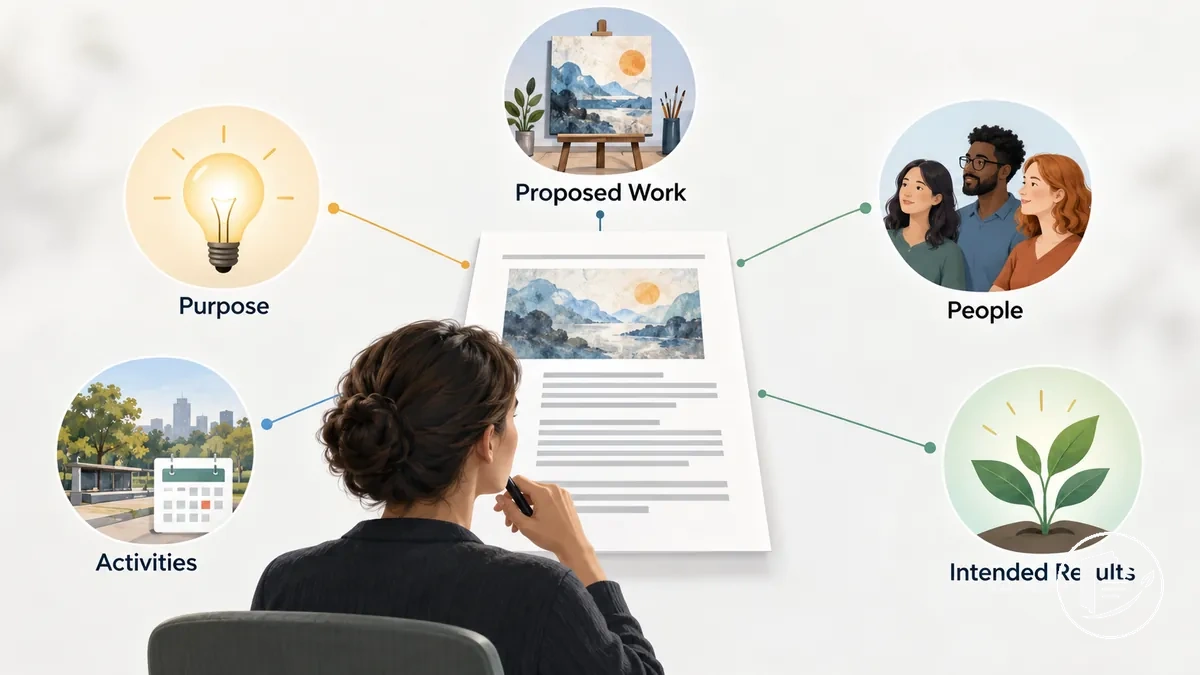
A project description must make the core project facts clear enough that a reviewer can identify the proposed work, its purpose, who is involved, where and when relevant activities happen, and how the project will be carried out without guessing.
These criteria define the information needed to understand the project itself rather than the requirements of the full grant application.
Missing or unclear information can leave the reviewer unable to connect the artistic idea with its participants, activities, context, and intended results.
The criteria below organize the main what, why, who, where, when, and how relationships that establish the project scope and show how its parts fit together.
- What — proposed work: Identify the artistic work, event, program, or other project being proposed so the reviewer can distinguish the central project from background information about the artist or organisation.
- Why — purpose and intended results: State the purpose of the project and the outcomes it is intended to produce so the relationship between the proposed work and its intended results is clear.
- Who — participants, collaborators, and audience: Identify the people involved in delivering or participating in the project and, where relevant, the audience it is intended to reach. Unclear roles can make the human scope of the project difficult to interpret.
- Where — place and context: State the location or setting when it affects the proposed work, participants, activities, or audience. If place is not relevant and the application prompt does not request it, it does not need artificial emphasis.
- When — timing: Give enough timing information to establish when the project and its key activities will occur without reproducing a detailed timeline that belongs elsewhere in the application.
- How — activities and execution: Describe the key activities that connect the project's purpose to its implementation so the reviewer can understand how the proposed work will be carried out without turning the description into a detailed budget or broader proposal strategy.
Knowing how to understand reviewer expectations can help an applicant judge whether the project description contains enough decision-relevant information.
Exact fields, limits, and levels of detail can vary by funder and application prompt, so the description should follow the requirements of the specific application.
The Artistic Idea and Proposed Work
The artistic idea is the concept the project explores, while the proposed work is the concrete artwork, event, performance, publication, or other creative work through which that concept takes form.
A clear project description connects the idea to observable attributes of the proposed work so a reader can understand what will actually be made, presented, developed, or delivered.
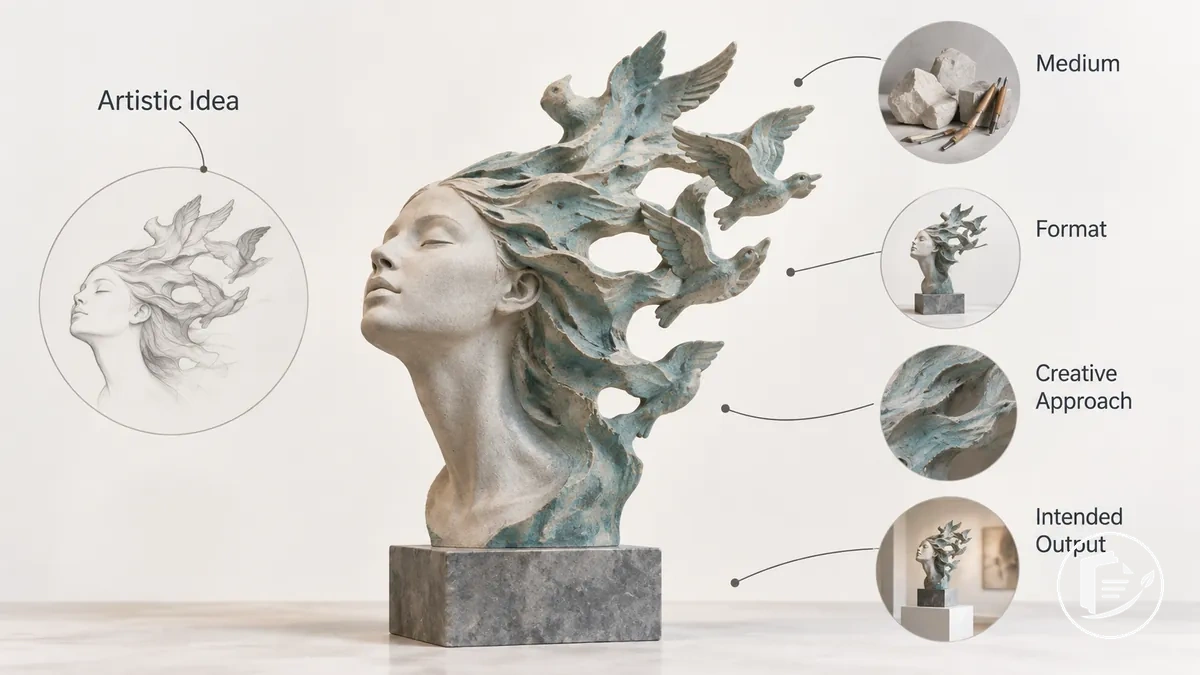
Describe the proposed work through its medium, format, creative approach, and intended output when those attributes are relevant and known.
An abstract statement such as “the project explores memory and place” identifies an artistic idea, but a concrete description also states what form the creative work takes and how that concept is expressed through it.
For example, an illustrative project description could propose an installation using recorded interviews and projected imagery, making its medium and format observable without relying on promotional adjectives.
These specific attributes make the artistic idea legible as a proposed work rather than leaving it as an aspiration.
Project Goals, Objectives, and Intended Outcomes
Project goals, objectives, and outcomes perform different functions in a project description, although funder terminology can vary.
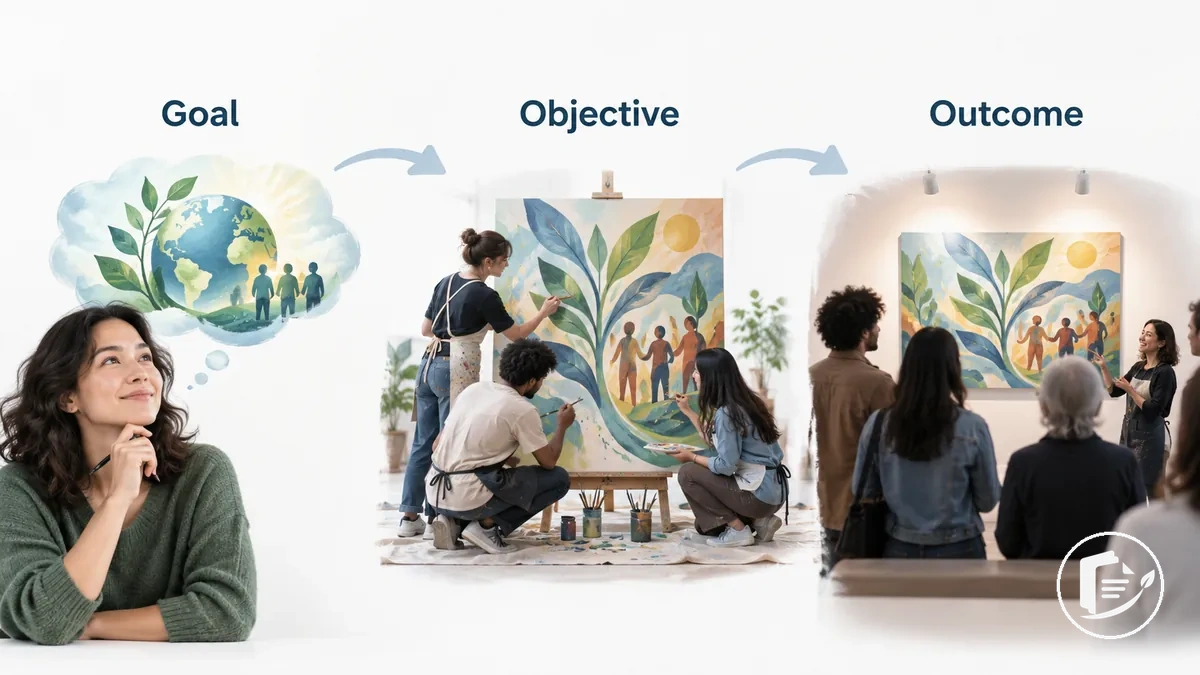
A goal describes the broad purpose or change the project is directed toward, an objective specifies a more specific result or milestone, and an outcome represents the intended effect or project result expected from the work.
| Component | Function in the Project Description | Art-Project Example |
|---|---|---|
| Goal | States the broad purpose or change the project aims to support. | Increase opportunities for a local community to engage with contemporary visual art. |
| Objective | Specifies a concrete result or milestone that contributes to the goal. | Develop and present a community-based exhibition created through collaborative workshops. |
| Outcome | Describes a plausible intended effect or result of completing the project. | Participants have opportunities to contribute creative work, and audiences can encounter the resulting exhibition. |
The relationship moves from broad purpose to a more specific result or milestone and then to the intended effect associated with the completed project.
In the example, the goal establishes the direction, the objective describes what the project will accomplish, and the outcome states the effect expected from that activity without presenting the effect as certain.
This progression helps keep each component connected to the proposed project rather than turning the project description into a separate measurement framework.
Because an application prompt or grantmaker may define goal, objective, and outcome differently, use the funder's own terminology where its definitions differ.
Project Scope, Participants, Audience, Place, and Key Activities
Project scope is the practical boundary formed by the participants and collaborators involved, the audience the work is for or affects when relevant, the place where activity occurs, the major activities, and the scale of the proposed work.
Together, these attributes identify what the project includes and the conditions within which it will operate.
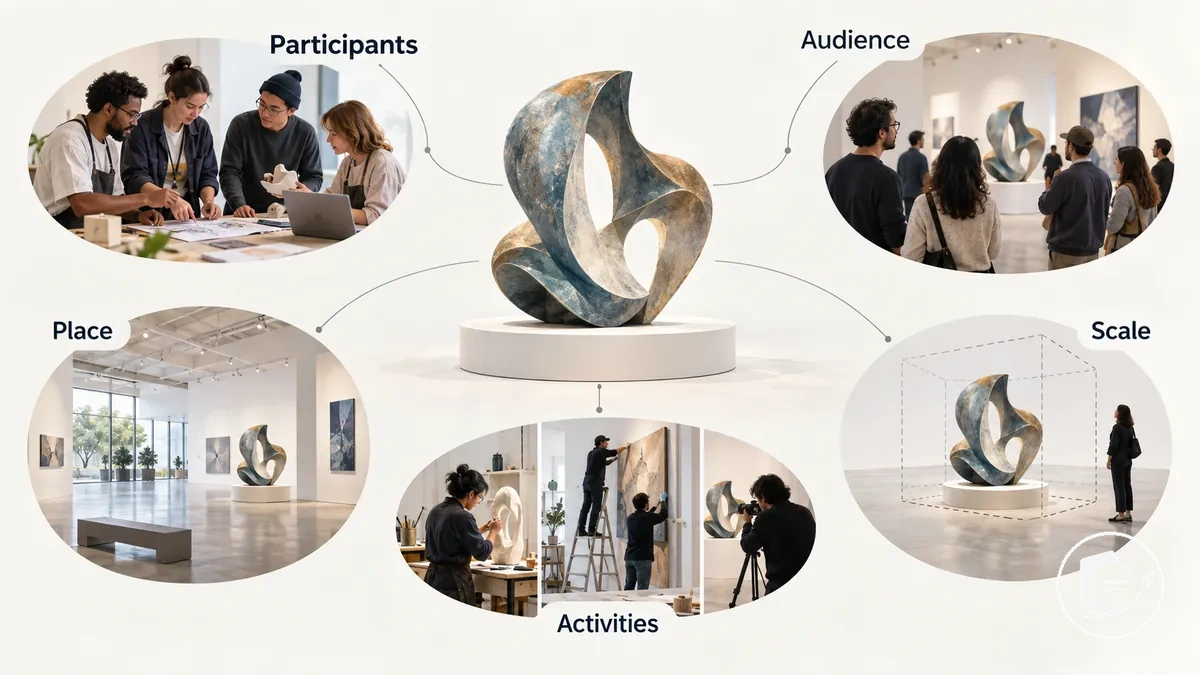
- Participants and collaborators: Identify the people involved and their relevant roles when those roles help define who will create, contribute to, or deliver the project. If participation is tentative, state that condition rather than presenting it as confirmed.
- Audience: Describe the intended audience or people affected when they are relevant to the project scope. Avoid presenting an expected audience size as certain when attendance or reach has not been established.
- Place: State the location or setting when it affects how the project will operate, who can participate, or how the work will be presented. If a place is proposed but not confirmed, describe it as proposed or subject to confirmation.
- Activities: Identify the major activities needed to understand what happens within the project, such as creating, collaborating, presenting, exhibiting, or facilitating, without expanding into detailed scheduling.
- Scale and boundaries: State the practical scale or limits that materially affect feasibility, such as the extent of the work, the relevant group of people involved, or the project setting, using confirmed information where available.
These project scope attributes make feasibility and scale easier to understand because they connect the proposed work to the people involved, its audience, its setting, and the activities required to carry it out.
Include enough detail to establish the project boundaries, but exclude incidental information that does not change how the project can be understood or carried out.
Where participants, audience conditions, place, or scale remain unresolved, distinguish the tentative condition from confirmed facts rather than inventing certainty.
Keep the Project Description Distinct From the Artist Statement
The project description and artist statement serve different purposes in a grant application: the project description centers on the proposed project, its execution, and intended results, while the artist statement centers on the artist's practice, ideas, influences, and broader artistic context.
Keeping those subjects distinct helps each document provide the evidence relevant to its own purpose.
| Comparison Point | Project Description | Artist Statement |
|---|---|---|
| Purpose | Explains the proposed project and how it will be carried out. | Explains the artist's practice and the ideas that inform the work. |
| Primary subject | The specific proposed project. | The artist's broader artistic practice, ideas, and influences. |
| Typical evidence | Concrete project details such as the proposed work, activities, participants, context, execution, and intended results. | Descriptions of recurring ideas, approaches, influences, materials, or concerns that help explain the artistic practice. |
| Question answered | What is this project, and what will be done to carry it out? | What characterizes this artist's practice and the ideas behind the work? |
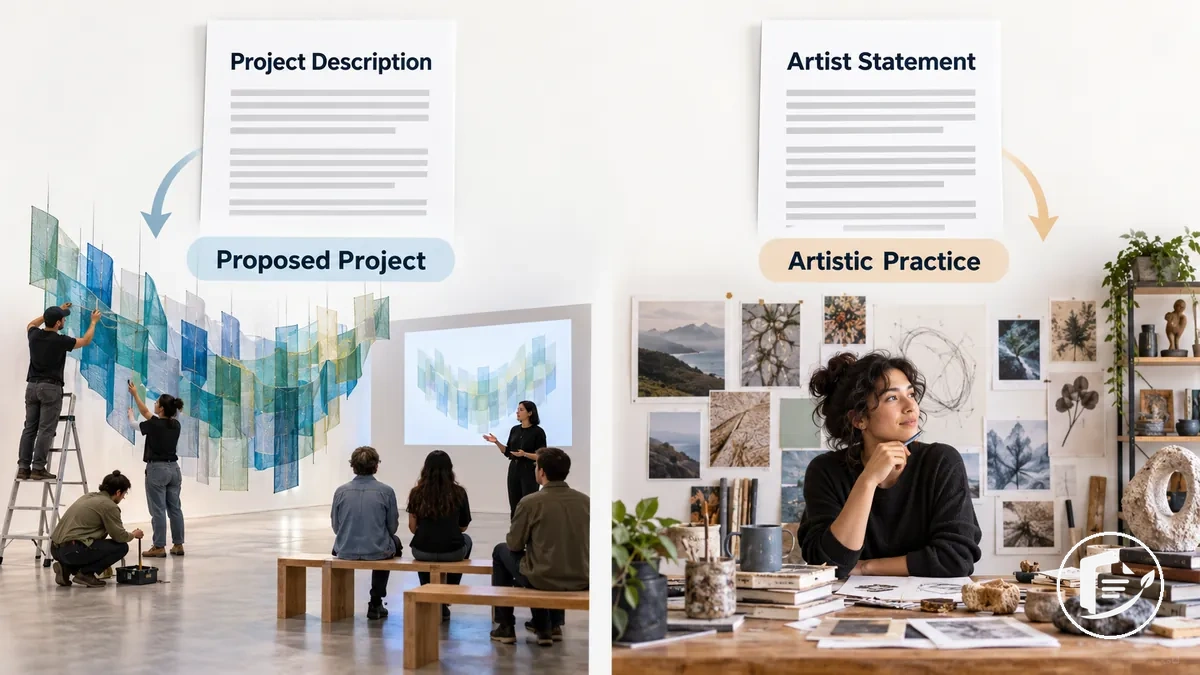
For example, the same artistic idea might appear in a project description as a concrete plan to create and present a particular installation, while an artist statement might discuss how that idea relates to recurring themes or influences across the artist's practice.
The distinction is therefore one of subject, purpose, and supporting evidence rather than a rule that every application uses identical document boundaries.
Funder terminology and requested content can vary, so the application prompt should determine how these functions are labelled and separated.
Prepare the Project Facts Before Drafting
Begin drafting only after the project facts and application constraints that need to remain consistent have been collected and checked.
Verify the application prompt, required questions, word limit or character limit, and the known details of the proposed project before turning those facts into narrative prose.
Drafting readiness check
- Application prompt and required questions: Check exactly what the application asks the project description to address.
- Word limit or character limit: Confirm the stated length constraint for the relevant response field.
- Project title: Verify the project title and use the same title wherever the application refers to the project.
- Proposed work: Confirm what will be created, developed, presented, or delivered and which details are already fixed.
- Participants: Check who is involved and distinguish confirmed participants from people whose involvement is still tentative.
- Audience: Identify the intended audience when it is relevant to the proposed work, without inventing unsupported reach or attendance expectations.
- Location: Verify the location or setting where known, and flag a proposed or unconfirmed location accordingly.
- Timeframe: Check the known dates or timeframe without expanding the preparation into a detailed project timeline.
- Activities: Confirm the major activities needed to describe how the proposed work will be carried out.
- Goals and consistency: Verify the project goals and check that material project facts agree with corresponding information elsewhere in the application.
Preparation at this stage is about readiness and consistency rather than writing the full proposal, constructing the budget, or developing the detailed timeline.
Flag unresolved project details for verification before they are stated as facts.
Write the Project Description in a Clear Sequence
Recommended narrative order
- Name the project and its purpose. Start with what the project is and why the proposed work matters in its own artistic or community context.
- Establish the practical context. Identify the relevant participants, collaborators, audience, place, and timing so the reader understands the conditions around the work.
- Describe the major activities. Explain how the project will be carried out and connect those activities to the proposed work rather than listing disconnected tasks.
- State the outputs. Make the concrete deliverables or completed work legible before moving to broader results.
- Connect to intended outcomes. Show the plausible result the activities are intended to support without presenting a broader effect as guaranteed.
Use transitions that keep the rationale, practical details, activities, outputs, and intended outcomes connected as one account. A funder’s application prompt may require a different order, but the same relationships should remain clear.
Keep this sequencing focused on the project description; the broader task of assembling all application components belongs to the process used to write the full art grant proposal.
State What the Project Is and Why It Matters
Open the project description by naming the project and proposed work, then state its purpose or significance without preamble.
Connect the reason for the project to the work itself: explain its artistic purpose or, where relevant, its community purpose rather than making a broad claim about the importance of art.
Example opening
“The project will create a series of site-specific installations using stories collected from local participants. Its community purpose is to connect those stories to the places where they were recorded, making local experiences the subject of the proposed work.”
Identify Who Is Involved, Where the Project Happens, and When
State the project logistics clearly enough to identify the people involved, the location or venue, and the dates or timeframe needed to understand how the project is expected to happen.
Logistics to state
- People
- Name participants or collaborators when the application requires names; otherwise identify the relevant roles that explain who will create, contribute to, or deliver the project.
- Place
- Describe the venue or location by its actual status and at the level needed to understand how the project will operate.
- Time
- Give confirmed dates or an appropriate schedule window without reproducing the detailed project timeline.
- Status
- Describe an unresolved collaborator, venue, approval, or date as planned, proposed, expected, or subject to availability rather than as confirmed.
When more scheduling detail is required, connect the project description to the timeline so the description states the timing while the timeline carries the detailed sequence.
Explain How Project Activities Lead to the Intended Outcomes
Project logic
State observable outputs directly when they follow from the activity; frame broader effects as outcomes the project is intended to support or contribute to.
- Workshop activity: run a series of artist-led workshops → output: completed participant works or collaborative material → intended outcome: support participant engagement with the project theme.
- Production activity: create a new body of work → output: finished artworks ready for presentation → intended outcome: support the artistic purpose described in the project goal.
- Exhibition activity: present the completed work in a public setting → output: a delivered exhibition or presentation → intended outcome: provide audiences with an opportunity to encounter the work and its subject.
Make the Description Specific, Clear, and Concise
The right level of specificity gives a reviewer enough concrete information to picture the project and assess its coherence without being buried in incidental detail.
Include relevant detail when it clarifies a necessary project fact or changes understanding of what the project will do, who is involved, where or when it happens, why it matters, or how it will be carried out.
Clarity comes from making those relationships explicit, while concision comes from removing redundancy rather than necessary information.
Test each detail against its function in the project description, the application prompt, and the available word limit.
A detail is useful when it supports the reader's understanding or answers something the application asks; it can usually be excluded when it adds technical, decorative, or background information without changing that understanding.
Keep, condense, or remove?
- Keep it if it clarifies the project: the detail makes the proposed work, participants, location, timing, purpose, or activities more concrete.
- Keep it if the application requires it: the detail responds directly to the application prompt or supplies a project fact needed to assess the proposal.
- Condense or remove it if it adds little understanding: the detail repeats information, exceeds the useful level of specificity, or consumes limited space without clarifying the project.
The amount of detail can change with the application prompt and word limit, so there is no universal length that makes a project description sufficiently precise.
Preserve the project facts needed for clarity, then achieve concision by tightening wording and removing repetition rather than omitting necessary detail.
Review the Project Description for Common Mistakes
Three checks before submission
Can a reviewer understand the proposed work, its people, place, timing, and major activities without having to infer missing facts?
Do the major activities lead to identifiable outputs, and do those outputs plausibly support the stated goal or intended outcome?
Do material project facts agree within the description and with related information in the budget, timeline, and other application components?
Treat an unclear statement or contradiction as a problem to correct. Any effect on reviewer interpretation or the funding decision is a possible consequence, not a guaranteed result.
Vague or Abstract Project Language
Vague language and abstract language weaken a project description when they prevent the reader from forming a concrete model of the proposed work.
A generic claim or undefined ambition can obscure project meaning when it leaves important actors, activities, conditions, or outputs unspecified instead of connecting the idea to observable project facts.
Recognise vagueness by checking whether a claim identifies who will act, what they will do, under what relevant conditions, and what output is planned.
Improve specificity by replacing unsupported adjectives and broad ambitions with concrete wording that names the missing entities, actions, conditions, or outputs without adding irrelevant detail.
If the project is intentionally exploratory, preserve that uncertainty while stating the planned process and its boundaries.
“The project will create an innovative and meaningful artistic experience that engages the community.”
“The project will bring local participants into artist-led workshops to develop material for a public installation, with the completed installation as the planned output.”
Goals, Activities, and Outcomes That Do Not Connect
Project logic becomes inconsistent when a goal or objective, its supporting activity, and the intended outcome describe different purposes or results.
The mistake is a lack of logical fit: the stated project work does not clearly support the objective, or the intended result does not plausibly follow from the activities described.
Review the relationship from objective to activity to intended result rather than adding new goals or activities during the review.
Use this three-part consistency check to locate a mismatch and decide whether the existing activity should be clarified, linked more directly, or removed.
- Goal or objective: identify the purpose or result the project says it is working toward.
- Supporting activity: verify that each major activity serves that stated objective rather than introducing an unrelated project purpose.
- Intended outcome: check whether the intended outcome is consistent with the described work and can plausibly follow from it without treating sequence or association as proof of impact.
An objective focuses on developing new collaborative work with local participants, but the described activity is a solo studio production with no participant involvement.
Include the planned collaborative process if it is genuinely part of the project; otherwise revise or remove the unsupported objective so the objective, activity, and intended result describe the same project logic.
Details That Conflict With the Budget or Timeline
Cross-document consistency is weakened when activities or other project facts in the project description conflict with the budget or timeline.
The relevant mistake is a material contradiction, such as described work that is unsupported by stated resources or dates that do not match the sequence or duration presented elsewhere in the application.
Check substantive conflicts rather than treating every wording difference as an error.
This review verifies whether the project description is consistent with the stated resources and schedule; resolving the underlying cost structure belongs to the separate task of how to align the project with the grant budget.
- Activities and resources: check whether each major activity has corresponding resource implications in the budget rather than appearing unsupported by the stated resources.
- Scale and participants: check whether the described scale and participant involvement are plausible for the resources stated in the application; where the information is insufficient, mark the relationship for confirmation rather than assuming it is infeasible.
- Dates and sequence: check whether dates and the order of activities in the project description match the timeline rather than placing dependent activities in a conflicting sequence.
- Duration: check whether the duration stated for an activity is consistent with the period allocated to it in the timeline.
The project description includes a public exhibition, but the timeline ends after artwork production and provides no period for the exhibition.
Confirm whether the exhibition belongs within the project, then revise the conflicting project description or timeline so both documents represent the same planned work.
Art Project Description Example: How the Structure Fits Together
This fictional art project description demonstrates how the proposed work and its purpose can connect with participants, audience, place, timing, activities, and intended outcomes in one coherent project narrative.
The example shows these relationships together rather than treating each project attribute as an isolated requirement.
In this scenario, an artist proposes a community-based installation developed through workshops with local participants and presented to a public audience.
Fictional project description
“The proposed work is a temporary installation created from recorded stories and visual material developed with residents of a coastal community. Its purpose is to explore how personal memories connect people to changing local places. Over a six-week development period, the artist will lead four workshops with local participants at a community arts space, using the resulting stories and visual material to develop the installation. The completed work will then be presented at the same venue for a public audience. The activities are intended to produce both the completed installation and opportunities for participants and audiences to engage with local experiences represented through the work.”
The example works because the artistic idea establishes the purpose, the participants contribute through defined activities, the place and timing establish where and when the work develops, and the activities connect to identifiable outputs and intended outcomes.
A different funder's application prompt or word limit could require changes to the level of detail, terminology, timing information, participant information, or emphasis while preserving internal consistency among the project facts.