
Creating an Artist Grant Project Timeline
Create an artist grant project timeline by fixing the eligible funded period and immovable dates first, then break the project into major activities and milestones, map dependencies, and only then assign realistic dates, durations, and risk-based buffer. The timeline is the project execution schedule—not the grant application or review calendar, so grant-funded activities should fit the funder's permitted period and remain consistent with the project description and budget.

Artist grant timeline planning blueprint
Plan from constraints to dates—not the other way around. Each step produces the input needed for the next.
- Lock the funded window
Confirm eligible start and end dates, award timing when relevant, and any immovable event, venue, or partner commitments.
Result: usable scheduling window - Turn outcomes into work units
Convert each project outcome into major activities; mark meaningful milestones or deliverables and responsibility where coordination depends on it.
Result: schedulable activity set - Map dependencies
Identify predecessors, successors, prerequisites, and work that can genuinely run in parallel before assigning dates.
Result: stable activity sequence - Assign timing and targeted contingency
Estimate dates and durations from complexity, availability, lead times, approvals, and fixed commitments; add buffer only where a plausible risk can affect later work.
Result: feasible dated schedule - Cross-check the application
Match the schedule to the project description and related budget information, then review activity coverage, milestones, dependencies, timing, and clarity.
Result: consistent grant timeline
A useful timeline entry makes these visible
- Activity
- Timing
- Milestone or deliverable
- Dependency
- Responsible party when coordination depends on it
Exact dates, detail, and format depend on the funder's instructions and the project itself. Apply the planning logic above within the funder's eligible period, required format, and any page or field limits.
Table of Contents
Set the Grant-Funded Project Period and Date Constraints
Planning the grant-funded project period starts by separating dates the funder or project cannot move from dates the artist can still adjust.
Fixed date constraints set the boundaries of the scheduling window, while flexible planning dates can move within those boundaries as project activities are scheduled.
The eligible start date and eligible end date define the funded period when the funder's rules specify those boundaries.
Notification timing matters when the permitted or feasible project start depends on when an award decision is communicated.
A fixed event date, such as an exhibition or performance, limits how late preceding activities can occur, while a venue or partner commitment can create another immovable constraint.
Dates not fixed by funder requirements or project commitments remain adjustable within the usable project window.

- Eligible start date: verify the earliest date the funder permits for grant-funded activity; work that must occur earlier needs to move, wait where possible, or fall outside the funded period.
- Eligible end date: verify the latest permitted date; activities finishing later must move earlier or fall outside the funded period.
- Notification timing: if the feasible or permitted start depends on the award decision, activities requiring that decision must wait until the relevant condition is met.
- Fixed event date: treat a confirmed exhibition, performance, presentation, or similar event as immovable when it cannot be rescheduled; preceding activities must fit before it within the scheduling window.
- Venue or partner commitment: record confirmed availability or delivery commitments as fixed when they cannot move; dependent activities must fit around those dates.
- Adjustable project dates: identify activities without fixed external constraints and move them within the remaining project window to fit the established boundaries.
For example, if an exhibition has a fixed opening date, that date narrows the production window because production, installation, and other necessary preceding activities must fit before it rather than moving with the rest of the plan.
After fixed constraints and adjustable dates are classified, the interval permitted by the applicable eligible boundaries and immovable project commitments is the usable grant-funded project period for task-level scheduling.
Break the Artist Project Into Activities and Milestones
Break the artist project down from each intended project outcome into major activities, then identify the milestone or deliverable that marks meaningful progress or completion.
Each activity should become a schedulable work unit that clearly advances the relevant outcome.
Derive the activities from the scope established in the project description and goals, then group the work at a level that is useful for timeline planning.
Activities such as research, material acquisition, production, rehearsal, installation, or presentation may be appropriate when they genuinely form part of the proposed artist project.
Where execution depends on a collaborator or partner, record responsibility so ownership of the relevant work unit is clear.

- Identify the project outcome or deliverable. State the result the planned work is intended to produce; the check is that each later activity can be connected to this result.
- Break the outcome into major activities. Identify the substantial work required to reach it; the check is that each activity represents a schedulable work unit rather than a broad intention.
- Group minor tasks. Combine micro-tasks that do not need separate timeline entries; the check is that the remaining work items are detailed enough to schedule without becoming an exhaustive task inventory.
- Mark milestones or deliverables. Identify significant completion points or project states that show when a meaningful stage has been reached; the check is that each milestone represents a checkpoint rather than work being performed.
- Assign responsibility where relevant. When a collaborator or partner affects execution, identify the responsible person for that activity or deliverable; the check is that ownership is clear wherever coordinated work depends on it.
Keep the decomposition practical: a production phase may contain several minor tasks without requiring every task to become a separate timeline entry.
Once the project activities and milestones are expressed as useful work units and checkpoints, they are ready to be sequenced.
Sequence Activities by Project Phases and Dependencies
An activity dependency exists when one activity relies on another activity or prerequisite before it can start or finish.
The prerequisite acts as the predecessor, while the dependent activity is the successor that follows it in the project sequence.
Order each project phase according to real dependencies rather than arbitrary dates: work with a genuine prerequisite must wait for that condition, while an independent parallel task can proceed concurrently.
For example, production may require research to be complete, while documentation preparation may be able to run in parallel with other work.
The sequence should make each prerequisite, dependent activity, and scheduling consequence explicit without imposing one phase model on every artist project.
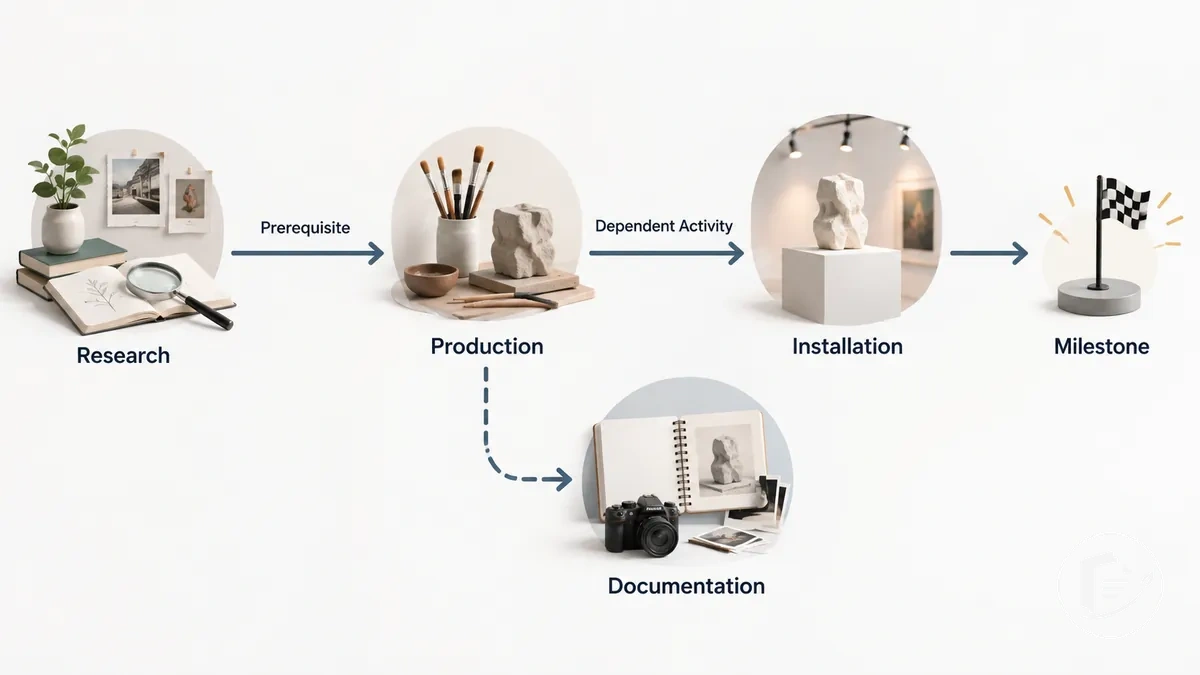
- True dependency: the second activity must wait when its required predecessor or prerequisite is incomplete.
- Parallel activity: the second activity can proceed independently when completion of the other work is not a prerequisite.
- Start with the earliest required activity or project phase. Identify its prerequisite, if one exists; without a prerequisite inside the project, the activity does not need to wait for another project activity.
- Identify the dependent activity. Mark the predecessor it requires; the successor must wait when that prerequisite has to be completed first.
- Separate parallel work. Identify activities that do not require completion of the preceding work; those activities can run in parallel rather than extending the sequence unnecessarily.
- Continue through later phases. For each activity, identify its prerequisite and whether subsequent work must wait or can proceed concurrently.
- Mark the milestone. Identify the completion point that follows its required predecessor activities; this confirms where the dependency sequence reaches a meaningful project checkpoint.
In a hypothetical installation project, if fabrication must finish before installation can begin, a fabrication delay may create a downstream delay by shifting installation and a later milestone unless parallel work or available scheduling flexibility absorbs the change.
Once predecessor-successor relationships and parallel tasks are clear, the activity order is stable enough for dates and durations to be assigned.
Assign Realistic Dates, Durations, and Buffer Time
Assign each start date, end date, and duration only after the activity order is clear, using actual execution conditions rather than optimistic guesses.
Where timing is uncertain, use a realistic date range instead of implying an exact duration that the available project conditions cannot support.
Estimate activity timing from the conditions that determine how long the work can realistically take.
Internal complexity affects the work duration, while collaborator availability, venue or partner commitments, material delivery, approval requirements, and production lead time can constrain when work starts or finishes.
A fixed date should remain fixed when it represents an immovable commitment, while an estimated work window can be adjusted when its underlying conditions change.
These factors provide the basis for deciding whether additional contingency is appropriate.

- Task complexity: estimate duration from the actual work required; more involved execution can require a longer work window than a simpler activity.
- Collaborator availability: adjust the start date or date range when an activity can occur only while a required collaborator is available.
- Venue or partner commitments: treat an immovable confirmed commitment as a fixed date and fit adjustable activity timing around it.
- Material delivery: allow for delivery lead time when work cannot proceed until required materials arrive; uncertain delivery can justify contingency before dependent work.
- Approvals: allow for an approval period when an activity must wait for a decision or sign-off; uncertain approval timing may require a wider scheduling margin.
- Production lead time: include externally required production time before assigning the relevant end date; a longer confirmed lead time extends the usable work window or requires an earlier start.
For example, if an external material delivery must occur before production can start, an uncertain delivery lead time may justify buffer time before production; if delivery shifts, the adjustable production date range may move while a fixed event date remains unchanged.
The resulting schedule should remain credible and adjustable as execution conditions become clearer.
Align the Timeline With the Project Description and Budget
Timeline alignment means the same major activity appears at compatible timing in the project description, with related resource needs reflected in the budget when a distinct cost category applies.
The timeline, project description, and budget should therefore remain consistent about what the activity is, its project purpose, and when any related costs are needed.
Trace each major activity across the timeline, project description, and budget to compare its timing, project purpose, and related cost category.
This cross-check makes a mismatch visible without assuming that every activity requires a separate budget line.

| Activity | Timeline timing | Project-description purpose | Related cost category (if any) | Consistency check |
|---|---|---|---|---|
| Research | Research phase | Develops the material or direction needed for later project work | Research-related resource need, if applicable | Aligned when the stated purpose and any related resource need correspond to the research timing |
| Production | Production phase | Creates the planned artistic work or project output | Production materials or services, if applicable | Requires review when a production cost appears in a period with no corresponding production activity |
| Presentation | Presentation phase | Delivers or presents the project output in its intended context | Presentation-related resource need, if applicable | Aligned when the activity timing, stated purpose, and any related cost occur in compatible parts of the project |
A project task with no distinct resource need can be a legitimate no-cost activity, so the absence of a separate budget line is not automatically a mismatch.
By contrast, a production expense appearing in a period when the timeline shows no production activity may require correction or clarification; where detailed cost treatment is needed, match the timeline to the grant budget without turning the timeline into a budget-construction exercise.
Review the Timeline for Clarity, Feasibility, and Consistency
A finished timeline should have enough clarity to make the planned work understandable, support feasibility within the funded period, and maintain consistency with the rest of the application.
Timeline review therefore tests whether the schedule is operationally credible under the project's stated conditions, not merely whether its dates are easy to read.
Review each criterion against an observable condition in the completed timeline and treat the result as either a pass signal or a reason for revision.
The checklist moves from activity coverage and sequence through timing and dependency handling to consistency with the project description and budget.
- Activity coverage: pass when all major project activities needed to represent the planned work appear in the timeline; revise when a major activity is missing.
- Milestone visibility: pass when significant milestones are clearly identifiable; revise when important completion points cannot be located.
- Sequence: pass when activities appear in a logical order that reflects how the project can be carried out; revise when the sequence conflicts with required ordering.
- Timing: pass when activity timing is feasible within the funded period under the project's stated conditions; revise when the schedule relies on timing that the project conditions do not support.
- Dependency handling: pass when required dependencies are represented in the sequence; revise when a dependent activity is scheduled without its prerequisite being accounted for.
- Buffer: pass when buffer is included where justified by plausible scheduling uncertainty; revise when a material timing risk is present but the schedule provides no reasonable contingency.
- Cross-document consistency: pass when activities and timing correspond with the project description and related budget information; revise when a mismatch appears across those application components.
A timeline can have strong clarity yet still lack feasibility if it is visually readable but relies on unrealistic timing or overlooks a dependency; a readable timeline is operationally credible only when its sequence and timing also fit the project conditions.
Once the timeline-specific review is complete, broader final application checks can address submission requirements beyond the timeline itself.
Choose a Timeline Format That Fits the Grant Requirements
The funder requirements take priority when they prescribe a timeline format through a form field, attachment, or other submission instruction.
When no format is prescribed, use the simplest timeline format that provides sufficient readability and makes the project sequence and dependencies clear within any applicable page limit.
| Format | Strength | Limitation | Suitable when |
|---|---|---|---|
| Chronological list | Provides straightforward readability and presents activities in sequence compactly. | Dependency visibility can be limited when several activities overlap or relate to one another. | The funder requirements allow a compact format and the sequence can be understood without extensive visual relationships. |
| Milestone table | Makes milestones and associated dates easy to scan in a structured layout. | Uses more space than a simple list and may show dependencies less directly than a visual chart. | The grant requirements allow tabular information and milestone visibility is important within the available space or page limit. |
| Gantt-style chart | Makes sequence, overlapping tasks, and dependency visibility easier to represent visually. | Uses more space and visual complexity, which can be unsuitable for a constrained form field or page limit. | The funder requirements permit a visual attachment or layout and the project relationships benefit from being shown spatially. |
A Gantt-style chart is one representation of the same project timeline, not a different planning task, and greater visual complexity does not automatically make the timeline more suitable.
A chronological list may fit a compact submission, a milestone table may suit milestone-focused information, and a Gantt-style chart may help when overlapping work or dependencies need stronger visibility; the appropriate choice remains conditional on the funder's instructions, available space, and the information the format needs to communicate.
Use Enough Detail to Make Tasks and Dependencies Clear
A timeline entry needs enough detail to show the activity, timing, milestone or deliverable it supports, and any relevant dependency without listing every micro-task.
The appropriate specificity should make execution understandable while keeping the schedule readable.
The useful detail level depends on project complexity, funder instructions, collaborator involvement, and the number of interdependent activities.
Each entry should communicate the minimum information needed to understand what occurs and how it fits the project, with a responsible party identified when responsibility materially affects execution.
- Activity: specify the concrete task or work being performed rather than using a vague catch-all description.
- Timing: state when the activity occurs using the level of timing detail appropriate to the project and funder instructions.
- Milestone or deliverable: identify the relevant checkpoint or output when it helps clarify what the activity supports or completes.
- Dependency: state what must occur first when another activity, approval, delivery, or condition affects execution.
- Responsible party: identify the person, collaborator, or partner responsible when ownership materially affects coordination or execution.
A vague entry such as work on project does not identify a specific action or useful timing.
A more specific entry could state complete artwork production during the scheduled production period before installation, which clarifies the activity, timing, and dependency without fragmenting the work into every individual micro-task.
Common Artist Grant Project Timeline Mistakes
Artist grant project timeline mistakes matter when they make feasibility, sequencing, or consistency difficult to verify.
Problems such as dates outside the eligible funding period, a missing dependency, or an unrealistic duration can obscure whether the proposed activities can be executed as scheduled.
Review each timeline mistake by identifying its scheduling consequence, the cue that reveals it, and the correction needed.
The items below group related timing errors without implying that every mistake has the same significance or that every funder evaluates timelines identically.
Mistake → cue → correction
Dates outside the eligible funding period
activities scheduled before the permitted start or after the permitted end conflict with stated funding boundaries.
- Cue
- a project date outside those boundaries.
- Correction
- to move the activity within the eligible funding period or clarify that it falls outside grant-funded work where applicable.
Missing dependency
a dependent activity may appear able to start before its prerequisite is complete.
- Cue
- a successor activity scheduled without the required preceding condition.
- Correction
- to represent the dependency and adjust the sequence accordingly.
Unrealistic duration
an activity may not have enough time for the work described.
- Cue
- a duration that conflicts with known execution conditions, collaborator availability, or required production stages.
- Correction
- to revise the duration or surrounding timing to reflect those conditions.
No justified buffer time
plausible uncertainty may leave the schedule with no contingency where a delay could affect later work.
- Cue
- an uncertain external condition immediately preceding dependent activity.
- Correction
- to add buffer time where the specific scheduling risk justifies it rather than padding every activity.
Omitted delivery lead time or partner commitment
external work may delay a dependent activity when the schedule assumes materials, services, approvals, or partner input are immediately available.
- Cue
- an external dependency with no time represented for its required lead time or commitment.
- Correction
- to include the relevant delivery lead time or scheduling constraint.
Narrative mismatch or budget mismatch
the timeline becomes inconsistent when activity timing conflicts with the project narrative or related budget information.
- Cue
- an activity, project purpose, or cost appearing in an incompatible period across the documents.
- Correction
- to reconcile the timeline with the narrative and budget while preserving the actual project sequence.
Insufficient detail
vague entries can obscure what happens, when it occurs, or what it depends on.
- Cue
- an activity description that does not identify a specific schedulable action or useful timing.
- Correction
- to add enough specificity to make the activity and relevant dependency understandable.
Excessive detail
unnecessary micro-task fragmentation can reduce readability and obscure the major project sequence.
- Cue
- a timeline dominated by minor actions that do not need separate scheduling treatment.
- Correction
- to group related micro-tasks into meaningful activities while retaining important milestones and dependencies.
For example, if a fixed exhibition date cannot move and production depends on externally delivered materials, simply shifting the exhibition may not be a valid correction when delivery is delayed.
The correction is to represent the delivery lead time and dependency explicitly, then adjust controllable production timing or justified contingency around the fixed event date.
Artist Grant Project Timeline Example
Consider a hypothetical artist grant project that develops and presents a small body of new artwork.
This artist grant project timeline demonstrates how each project phase connects an activity and date range with a milestone or deliverable, while dependencies and a justified buffer preserve realistic sequencing within the stated project scope.
The dates are illustrative and do not represent a funder's required schedule or standard duration.
The example follows one coherent sequence from preparation through production and presentation.
The table shows where a downstream activity depends on a prerequisite and where a plausible external timing risk justifies buffer.
| Project phase | Activity | Date or date range | Milestone/deliverable | Dependency |
|---|---|---|---|---|
| Research and preparation | Develop references, confirm materials, and refine the production plan | 1–14 March | Research and preparation completed | Project start |
| Material acquisition | Order and receive materials required for production | 10–21 March | Required materials available | Material requirements identified during preparation |
| Production | Create the planned body of artwork | 22 March–30 April | Artwork production completed | Required materials available |
| Buffer | Allow contingency for a plausible material-delivery or production delay | 1–7 May | Schedule adjustment window | Used only if the identified timing risk affects production |
| Installation preparation | Prepare completed work and presentation materials for installation | 8–12 May | Work ready for installation | Production completed |
| Installation and presentation | Install and present the completed artwork | 13–17 May | Presentation delivered | Artwork and installation preparation completed |
The example shows sequencing by placing preparation before production and making presentation depend on completed artwork, while milestones and deliverables mark meaningful completion points rather than minor tasks.
Its buffer is tied to a plausible material-delivery or production risk rather than added to every project phase, and the level of detail remains consistent with the hypothetical project scope.
Within the wider artist grant proposal process, real dates, durations, dependencies, and milestones should be adapted to the actual project and funder conditions.
The transferable lesson is to make each activity's timing and relationship to the rest of the project explicit enough for the schedule to function as one coherent plan.