
Improving and Resubmitting a Rejected Artist Grant Application
A rejected artist grant application should be diagnosed before it is rewritten. Reapply when the project still meets the current eligibility and funding-fit conditions, you can make evidence-based substantive revisions, and the revised application can be made coherent and compliant with the current funding round; otherwise, wait for material gaps to be resolved or reconsider the opportunity. No revision can guarantee funding.

Resubmission decision and revision path
Use the rejected application and current funding round as the evidence base. Move through these four checks in order so that revision effort follows the problem actually supported by the application, feedback and funding conditions.
-
1
Diagnose the rejection evidence
Separate specific reviewer comments, outcome information and published criteria from assumptions. Treat missing or ambiguous feedback as uncertainty, not proof of a particular weakness.
-
2
Decide whether to reapply
Check current eligibility and project fit first, then revision readiness. A wording change cannot solve an underlying eligibility or fit problem.
-
3
Revise by consequence
Prioritise substantive issues that affect clarity, evidence, feasibility, fit or consistency. Preserve material that remains accurate, relevant, supported and compatible with the current round.
-
4
Verify the whole application
Trace changed claims through related activities, evidence, timing, costs and terminology, then recheck current questions, limits, dates, required material and submission conditions.
Timing cues
- Reapply
- Current eligibility and project fit hold, meaningful revision is ready, and applicable current-round requirements are verified.
- Wait
- A material evidence, project-development or revision gap still needs work before a suitable round.
- Reconsider
- A current eligibility or project-fit condition remains incompatible with the funding opportunity.
Start by interpreting the rejection evidence before changing individual passages; the detailed sections below then move from diagnosis to timing, revision, coherence and current-round verification.
Table of Contents
Interpret the Rejection Before Revising
Rejection evidence should be interpreted before revision begins because the available signals may not reveal one definite reason for the outcome.
Reviewer comments, an outcome notice, and explicit funding criteria can show what was recorded about the application, while other explanations may remain uncertain.
The first diagnostic task is therefore to separate what the evidence actually indicates from what the artist can only infer.
Observable evidence includes specific reviewer comments, statements in the outcome notice, the published funding criteria, and any explicit eligibility or project fit concerns.
These signals can be checked against the submitted application and the funding opportunity to establish what was actually stated or required.
Inferred explanations are different: when the funder provides no feedback, the absence of comments creates an information limitation rather than evidence of a particular weakness.
The image below reinforces this distinction by focusing on the available rejection evidence that can be reviewed before conclusions are drawn.

A specific criticism may indicate an application area that requires investigation, while positive reviewer comments may identify material that does not need wholesale replacement.
An explicit eligibility concern requires checking the relevant eligibility condition, and an explicit fit concern requires comparing the project with the funding criteria; neither should be treated as evidence of unrelated weaknesses.
When the available signals are insufficient to establish the cause, a deeper analysis may be needed to identify why the grant application was rejected without presenting a speculative explanation as fact.
The interpretation should lead to a revision decision rather than directly to rewriting.
Evidence-supported weaknesses can be investigated and revised, material that remains coherent with the funding criteria can be preserved, and unresolved questions should remain marked as uncertainty until better evidence is available.
This keeps the next decision tied to what the rejection supports, what still requires checking, and what the available evidence cannot establish.
Use Reviewer Feedback as the Starting Evidence
Reviewer feedback is evidence to interpret, not a literal instruction to rewrite the application.
An explicit comment can identify a stated criticism or concern, but its broader meaning may still require context.
Because feedback varies in specificity, the annotated example distinguishes evidence states that should not automatically receive equal weight.
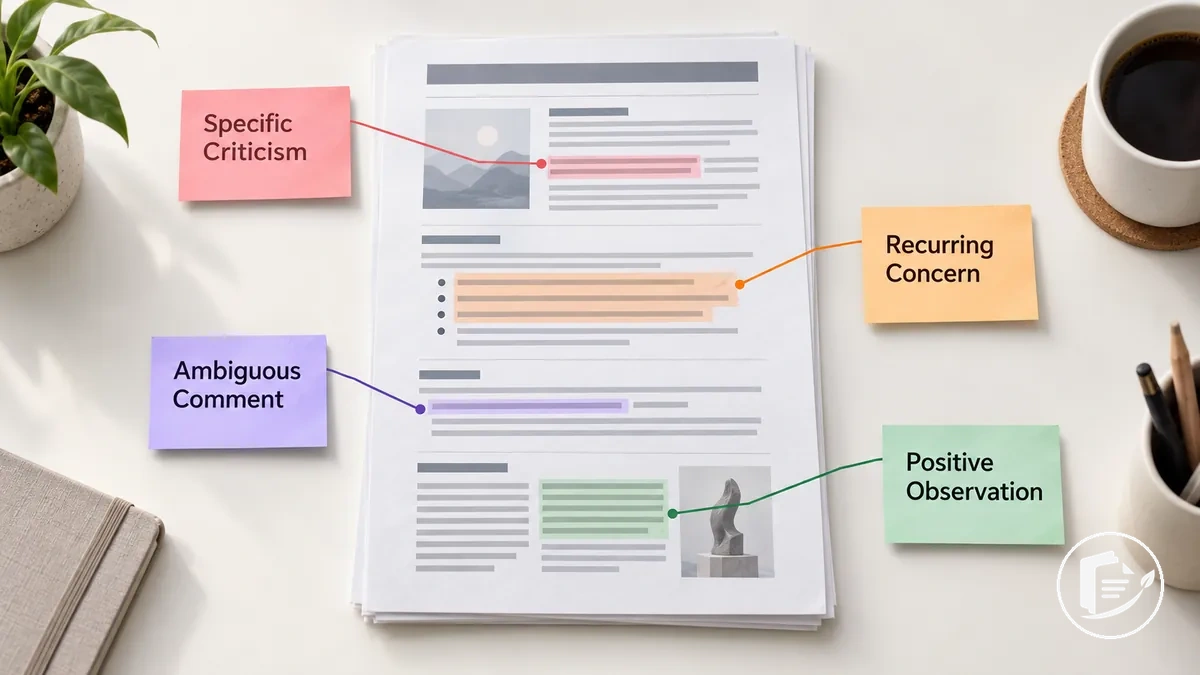
Specific criticism can identify a passage, claim, or supporting detail that warrants review for clarity or evidence.
A recurring concern across reviewer feedback can suggest that the same issue deserves closer attention wherever it appears in the application.
An ambiguous comment has less determinate meaning and should be checked against the surrounding application material and funding criteria before a change is made.
A positive observation can identify strong material that may be suitable for preservation rather than unnecessary revision.
These feedback states differ in specificity, so one reviewer comment should not be assumed to establish the sole reason for rejection.
Specific or recurring criticism supports a targeted review of the relevant clarity, evidence, or alignment issue; ambiguity calls for cautious interpretation rather than an automatic rewrite; and a positive observation supports preserving material when it remains relevant.
Reviewer feedback should ultimately be compared with the submitted application and the funding criteria so that each revision is proportionate to the evidence and its context.
Where that comparison does not resolve a comment's meaning or weight, the ambiguity should remain explicit rather than being converted into an assumed reviewer intention.
Separate Application Weaknesses From Grant-Fit Problems
An application weakness is a correctable problem in how the project is explained or supported, while a grant-fit problem concerns the relationship between the project and the funding opportunity.
The same rejection outcome can be consistent with either condition, and some applications can contain both.
The corrective direction therefore depends on whether the evidence points to the application itself, project fit, or a combination of the two.
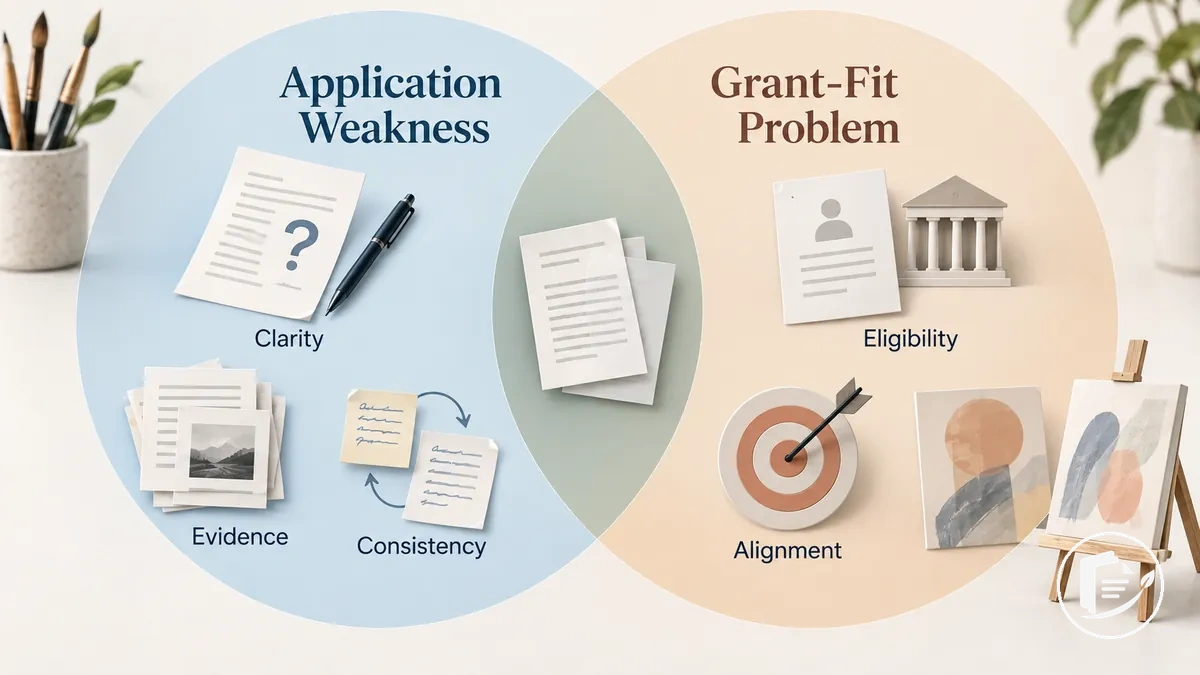
Diagnostic cues help distinguish the conditions without treating rejection itself as proof of either one.
An unclear explanation, weak evidence, or inconsistency between application materials may indicate an application weakness because the underlying project could still align with the funding opportunity.
By contrast, an explicit eligibility constraint, a substantial difference between the project and stated funding priorities, or limited project alignment may indicate a grant-fit problem.
Eligibility is established only where the applicable funding requirements set a condition that the applicant or project does not meet.
Mixed cases are possible when an application communicates the project poorly while the project also has uncertain alignment with the opportunity.
| Diagnostic Cue | Application Weakness | Grant-Fit Problem | Revision Implication |
|---|---|---|---|
| Clarity | An unclear explanation may obscure an otherwise relevant project. | Clear wording may still reveal limited alignment between the project and the opportunity. | Revise the explanation when clarity is the supported issue; investigate fit when clearer wording exposes an alignment concern. |
| Evidence | Weak support for a claim may reduce how clearly the application substantiates its case. | More supporting evidence may not resolve a mismatch with the opportunity's stated scope. | Strengthen support when the evidence gap is internal to the application; reconsider the opportunity when the underlying project remains outside the relevant scope. |
| Internal consistency | Inconsistency between application materials may indicate a correctable application problem. | Consistent materials can still describe a project with limited fit. | Correct conflicting material when consistency is the issue; investigate fit separately when consistency does not resolve the concern. |
| Eligibility | Unclear presentation of eligibility information may warrant clarification where the applicant or project meets the stated requirement. | A stated eligibility requirement that the applicant or project does not meet limits suitability for that funding opportunity. | Clarify qualifying information when presentation is the issue; wording changes cannot establish eligibility when a stated requirement is not met. |
| Funding priorities | The application may fail to explain a genuine connection to stated funding priorities. | The project itself may have limited connection to those priorities. | Clarify a supported connection when one exists; reconsider the opportunity when the underlying connection remains limited. |
| Project alignment | The application may communicate existing alignment incompletely or inconsistently. | The project's aims or activities may have limited alignment with the funding opportunity. | Revise how existing alignment is demonstrated, or investigate the opportunity mismatch when the project itself does not align closely. |
The distinction changes the corrective direction: evidence of an application weakness supports targeted revision, while evidence of a grant-fit problem may require reconsidering the funding opportunity rather than changing wording alone.
Where cues point in both directions or remain inconclusive, further investigation is more appropriate than forcing the problem into one category.
For the reapplication decision, the relevant question is whether revision can address the supported application weakness while the project still satisfies the applicable eligibility, funding priorities, and alignment conditions.
Decide Whether and When to Reapply
Reapply when the project still fits the funding opportunity, the applicant and project satisfy current eligibility conditions, and the application can undergo meaningful revision for the current funding round.
The reapplication decision should not rest on persistence alone, because timing also depends on actionable feedback, project readiness, and current requirements.
If those conditions are not yet established, waiting or reconsidering the opportunity may be more appropriate than immediate resubmission.
No single criterion decides every reapplication case, so the decision should move from basic suitability to revision readiness and timing.
Eligibility and project fit establish whether the funding opportunity remains relevant, while actionable feedback indicates whether a specific weakness can be addressed.
Project readiness matters when stronger evidence, clearer development, or other material project changes are still needed.
Current-round requirements—eligibility, assessment criteria, question wording, word or character limits, required materials, dates and submission instructions—must be confirmed because a later funding round may not use the same conditions as the rejected application.
Together, these criteria show why the timing decision can lead to reapply, wait, or reconsider rather than one universal response.
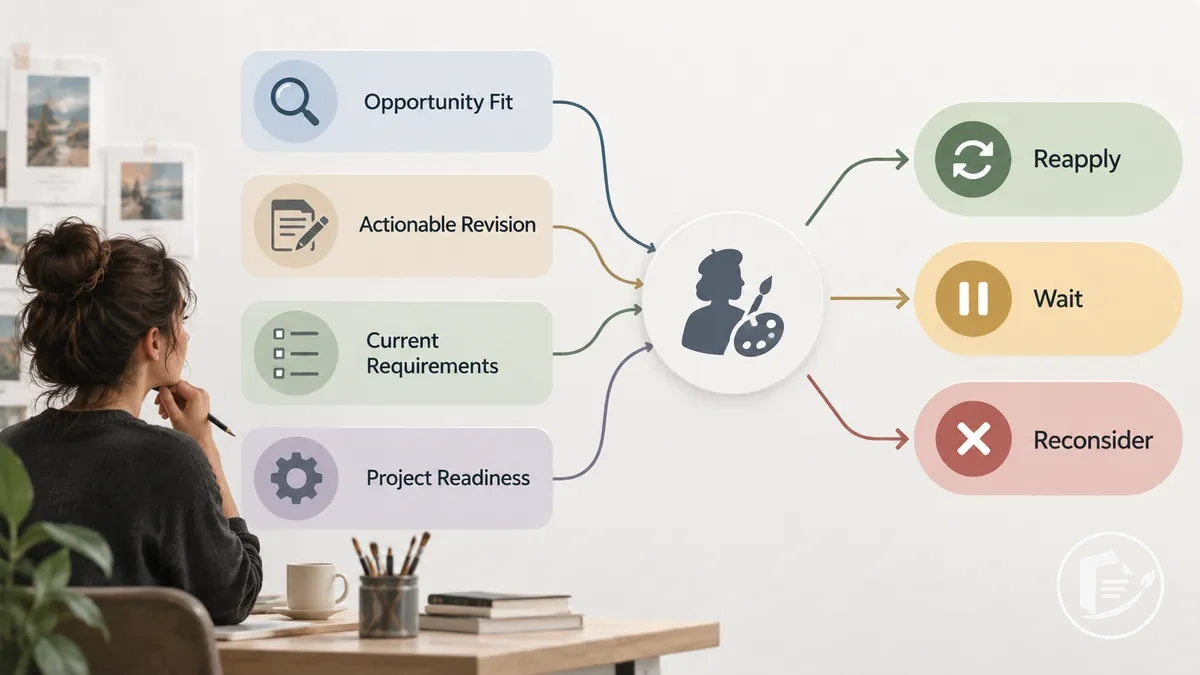
- Eligibility: if the applicant and project meet the current eligibility conditions, reapplication can remain under consideration; if a stated condition is not met, reconsider that funding opportunity unless the applicable requirements later change.
- Project fit: if the project still aligns with the opportunity's scope and funding priorities, that fit supports reapplication; if the underlying project no longer aligns, wording changes alone do not resolve the mismatch.
- Actionable feedback: if reviewer feedback identifies a concern that can be addressed with clearer explanation, stronger support, or better alignment, it provides a basis for meaningful revision; ambiguous or absent feedback may require further investigation before timing is decided.
- Project readiness: if the project is sufficiently developed to support the claims and materials required for the next funding round, an earlier resubmission may be feasible; if important evidence or project development is still incomplete, waiting can provide time for those conditions to change.
- Current requirements: if the next funding round retains requirements that the applicant and project can satisfy, the application can be assessed against that round; changed eligibility, questions, required materials, or priorities require reassessment before resubmission.
- Revision capacity: if the applicant can make meaningful revision before the relevant deadline, the next suitable round may be practical; if the application would remain materially unchanged despite identified weaknesses, waiting may support a more substantive response.
These criteria create three neutral timing paths: reapply in the next suitable round when the opportunity still fits, current requirements are satisfied, and meaningful revision is ready.
Wait when project readiness, supporting evidence, or the revision itself still needs material development, without assuming that waiting alone improves the outcome.
Reconsider the opportunity when eligibility or project fit remains incompatible with the current funding conditions.
Where the evidence is incomplete or mixed, investigate the unresolved condition before selecting a timing path.
A sound reapplication decision matches timing to conditions that can actually be verified: suitability for the funding opportunity, readiness for meaningful revision, and compliance with the current round.
The next funding round supports reapplication when those conditions are sufficiently in place; unresolved material conditions support waiting or further investigation, while a continuing fit or eligibility problem warrants reconsideration.
Build a Revision Plan From the Rejection Evidence
Build the revision plan from diagnosed rejection evidence before starting line-level editing.
The plan should convert each supported issue into a priority, an affected section, and a required type of change rather than treating the application as material to rewrite from beginning to end.
This sequence keeps substantive change ahead of a minor editing task when the substantive issue has greater relevance to the application.
The planning sequence moves from evidence capture to classification, prioritisation, application-component mapping, revision order, and verification.
Following that order prevents low-impact editing from consuming attention before substantive issues have been mapped to the parts of the application they affect.
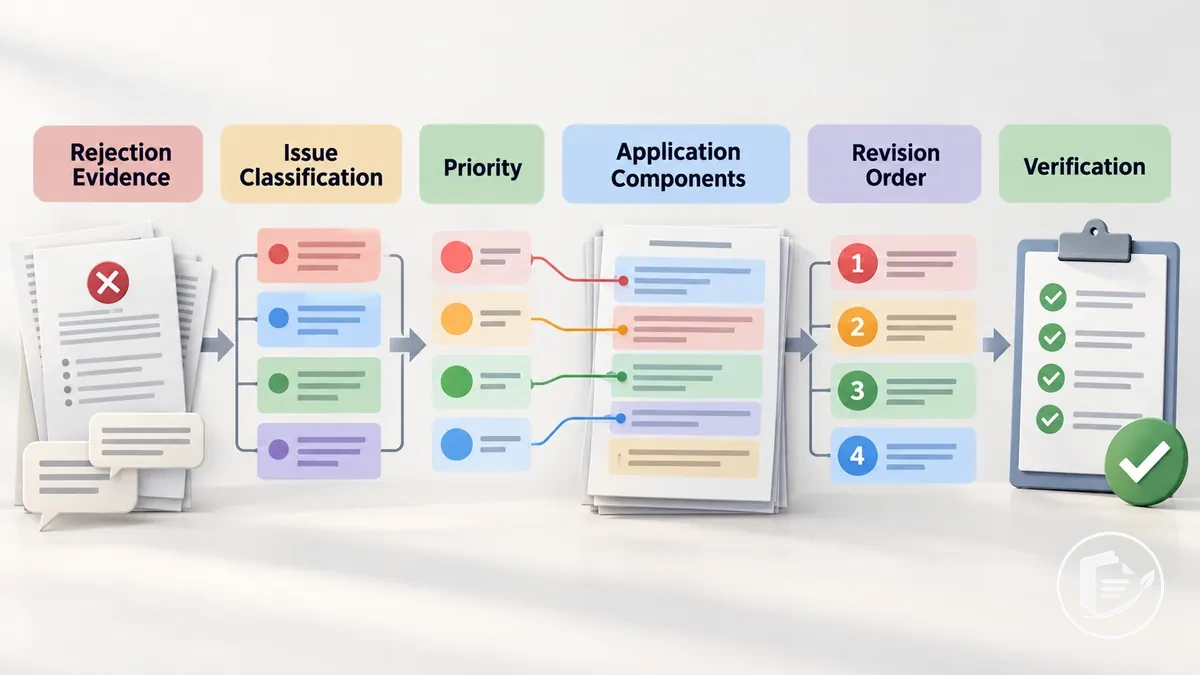
- Collect the rejection evidence. Record the reviewer comments, outcome information, and other diagnosed evidence that supports a revision issue. The planning output is a bounded evidence set that distinguishes supported issues from assumptions before priorities are assigned.
- Classify each issue. Identify whether the evidence concerns a substantive weakness, a consistency problem, or a minor editing task without introducing problems that the rejection evidence does not support. The output is an issue classification that indicates what kind of response may be required.
- Rank the impact. Give priority to issues whose unresolved consequence could materially affect clarity, support, alignment, or application-wide consistency, while placing minor surface corrections later in the sequence. When impact is uncertain, record the criterion used for the priority rather than assigning an unsupported severity score. The output is an ordered set of revision priorities.
- Map issues to application components. Connect every priority issue to the affected section or other application component and note any dependency on related material. The output is a map showing where each issue must be addressed and which connected components may need consistency checks.
- Order the revisions. Sequence substantive change before dependent or cosmetic work so that later editing is not based on material that may still change. The output is a revision order that identifies which application components should be addressed first and which tasks depend on those changes.
- Define verification points. For each planned change, state what will be checked after the change is made, such as whether the affected section addresses the identified issue and remains consistent with connected application material. The output is a set of verification points for assessing the completed revisions without assuming that the changes guarantee a different funding outcome.
Each issue in the revision plan should remain connected to three practical elements: the affected section or application component, the consequence of leaving the issue unresolved, and the type of substantive change or editing task indicated by the evidence.
A clarity issue may affect one passage, while a consistency issue may create dependencies across several application components.
The consequence determines why the issue deserves its assigned priority, and the required change determines where it belongs in the sequence.
If the evidence does not establish the likely consequence or scope of an issue, the plan should retain that uncertainty rather than inventing a precise ranking.
The completed revision plan stops at a ready-to-revise state: the evidence has been converted into classified issues, priorities, affected components, an ordered sequence, and verification points.
Detailed rewriting begins only after that planning structure is clear, keeping implementation separate from the decision about what needs to change and in what order.
Prioritise Substantive Changes Over Surface Edits
A substantive change should receive earlier revision priority than a surface edit when it addresses a weakness with a greater consequence for the application's meaning, fit, evidence, feasibility, or consistency.
Substantive revision changes what the application communicates or supports, while surface editing primarily improves wording, grammar, or style without resolving the underlying issue.
The distinction is based on consequence rather than which correction is easiest to make.
The revision priority should be assessed against clarity, fit, evidence, feasibility, and consistency because these criteria show whether an issue affects the substance of the application or can wait for a later surface-editing pass.
Higher corrective priority applies when a weakness obscures meaning, weakens a supported connection to the funding opportunity, leaves a material claim insufficiently supported, makes project delivery unclear, or creates conflicting information across application components.
Lower priority generally applies to wording or style corrections when the underlying meaning and support are already coherent.
The impact of any specific issue still depends on its consequence within the application and the relevant funding context.
- Clarity: an issue requires earlier attention when unclear meaning prevents the project, activity, or rationale from being understood; a surface edit can wait when the intended meaning is already clear.
- Fit: a substantive change has higher priority when the application does not adequately communicate a supported connection between the project and the funding opportunity; stylistic refinement does not resolve an underlying fit problem.
- Evidence: an unsupported or insufficiently supported material claim requires earlier attention when the missing evidence weakens the application's case; sentence-level polish cannot supply that support.
- Feasibility: an issue has higher corrective priority when it leaves important project delivery, resources, timing, or practical execution unclear; cosmetic corrections can follow once the substantive feasibility information is coherent.
- Consistency: conflicting information across application components requires earlier attention when the inconsistency changes or obscures what the application communicates; minor wording differences can wait when they do not create that consequence.
For example, if a material project claim lacks supporting evidence and the same passage also contains awkward sentence style, the evidence weakness takes corrective priority because it affects what the application substantiates, while the surface edit can follow.
Recurring writing errors may still need attention, but they should not displace higher-impact revision priorities; a later review can correct recurring grant writing mistakes after the substantive issues are addressed.
When both types of work are necessary, wording polish follows the higher-impact correction.
Preserve Strong Material That Still Supports the Application
Rejection does not automatically invalidate every part of the prior application.
Strong material can be preserved when it remains accurate, relevant, supported, and suitable for the current funding round.
Prior wording should therefore be retained because it still performs a necessary function in the revised application, not merely because it already exists.
Retained application material should first be checked for accuracy against the current project facts and for relevance to the question, criterion, or application component it serves.
Its claims should remain supported by appropriate evidence rather than depending on information that is no longer valid.
The material should also remain consistent with the current funding round, including any requirements or priorities that affect its function.
Even when a retained passage remains usable, surrounding context may require targeted revision if changes elsewhere alter how the passage connects to the application.
These conditions separate functional preservation from unverified reuse of prior wording.
- Preserve: keep strong material when it remains accurate, relevant, supported, consistent with the current funding round, and coherent with its surrounding context.
- Targeted revision: adjust material when its core function remains useful but changed project facts, current requirements, supporting evidence, or surrounding text alter part of its meaning or connection to the application.
- Remove: remove material when it is no longer accurate, relevant, adequately supported, or compatible with the function it needs to perform in the revised application.
The preserve, targeted revision, or remove decision should follow the material's present function and current context rather than attachment to previous wording.
This keeps usable content where it still supports the application while allowing dependencies and changed conditions to determine where further revision is necessary.
Revise the Application as a Coherent Whole
Revise the application as an interconnected whole rather than improving isolated passages.
A change is complete only after its possible effects on connected claims, evidence, activities, timing, costs, and terminology have been checked.
Coherence depends on tracing each substantive revision through the parts of the revised application that rely on or describe the same information.
Dependencies can connect the project description, application responses, evidence, budget logic, timing, and other application material.
A changed project claim may require supporting evidence or related responses to be updated when they depend on that claim.
A changed activity may affect timing or costs when those elements are linked to the activity.
Terminology should remain consistent where multiple sections refer to the same project element.
These relationships require cross-section alignment only where the revision actually affects a connected component.
- Make the high-impact revision. Revise the substantive issue identified for correction before adjusting dependent material. Before continuing, verify that the changed claim, explanation, activity, or other application element now expresses the intended information clearly enough to trace its dependencies.
- Identify affected sections. Trace the revised element to the project description, application responses, evidence, budget logic, timing, or other components that rely on the same information. Before continuing, verify which connected sections are affected and which can remain as they are.
- Update dependent material. Align each affected component with the substantive revision, including related claims, evidence, activities, timing, costs, or terminology where applicable. Before continuing, verify that dependent information no longer reflects an earlier version of the changed element.
- Cross-check connected sections. Compare references to the same project facts or commitments across the revised application. Before continuing, verify that explicit contradictions have been corrected and that connected sections describe the relevant information consistently.
- Check consistency and integration. Read the changed components in their application context rather than as independent passages, checking that evidence still supports the relevant claims and that activity, timing, and budget logic remain aligned where they are dependent. Integration is ready for final verification when the revised material functions consistently with the surrounding submission.
Final verification should assess the revised application across section boundaries, focusing on whether connected information remains mutually consistent after the changes.
A locally improved passage still requires further adjustment if it creates a contradiction, leaves dependent evidence outdated, or breaks an established relationship between an activity, its timing, and its budget logic.
Where a revision has no supported dependency on another component, that component does not require change merely for uniformity.
The revised submission reaches internal coherence when its integrated claims, supporting material, terminology, and dependent project information are consistent with one another.
Keep Revised Sections Consistent With the Rest of the Application
A revised passage can make related information elsewhere in the application inconsistent even when the local change is appropriate.
A changed statement should therefore be checked against each related claim that depends on the same project information.
A genuine contradiction requires correction, while legitimate differences in scope, date, or condition do not require identical wording.
Cross-section verification should trace each changed statement to dependent information about goals, activities, timing, costs, evidence, and terminology.
If a revised goal changes what the project is intended to achieve, related activities should be checked for alignment with that goal.
Changes to activities should be checked against relevant timing and costs, while revised claims should be checked against the evidence used to support them.
Terminology referring to the same project element should remain consistent unless a different term reflects a legitimate distinction.
The following consistency checks compare revised statements with related information elsewhere so that a contradiction can be identified and corrected.
- Goals to activities: check whether revised goals align with the activities intended to deliver them; correct a contradiction when the activities still reflect an earlier goal.
- Activities to timing: check revised activities against their related timing; correct dates or sequencing when they conflict with the changed activity.
- Activities to costs: check changed activities against related costs; correct budget logic when the costs still correspond to an earlier activity or scope.
- Claims to evidence: check each revised claim against its supporting evidence; correct the claim or support when the evidence no longer substantiates what the application states.
- Goals to related claims: check dependent statements elsewhere against revised goals; correct claims that describe an incompatible project purpose or outcome.
- Terminology to terminology: check terms for the same project element across revised sections; correct inconsistent terminology when it creates a contradiction or changes the apparent meaning.
Strengthen Evidence Where the Application Was Unclear or Unsupported
An unclear or unsupported claim needs a stronger connection to relevant evidence rather than simply more words.
The revision should clarify what the claim asserts, identify support that is relevant to that assertion, and state only the implication that the evidence can reasonably sustain.
This improves specificity and substantiation without turning added detail into unsupported certainty.
- Define the claim. Identify whether it concerns the project need, proposed activities, feasibility, expected result or another application assertion, and state what the claim actually needs to establish.
- Match relevant support. Identify the missing support and use evidence that directly substantiates or clarifies that assertion; extra description does not substitute for relevant evidence.
- Bound the implication. State only what the evidence can reasonably sustain. If support is limited or conditional, keep the claim correspondingly bounded; if relevant support is unavailable, narrow the claim rather than inventing evidence or certainty.
Example: Several extra sentences about a project's importance add detail, but they do not substantiate why the project is needed. Relevant information that directly addresses the stated need creates the clearer claim-to-evidence link.
Practical rule: Substantiation comes from evidence with a defined supporting function, not from verbosity alone.
Verify the Revised Application Against the Current Funding Round
A revised application must be verified against the current funding round rather than assumed to inherit the requirements of the earlier submission.
The current round's stated requirements govern the resubmission, including any criteria, limits, dates, instructions, and submission conditions that apply.
Where current information has not been confirmed, the earlier application's compliance should not be treated as evidence that the revised application still complies.
Verification should cover the current criteria and any required material that must accompany the application.
Confirm the applicable question wording and each stated word limit or character limit rather than carrying forward the earlier version automatically.
Check every relevant date, including the current submission deadline and any other dates that constrain the application where specified by the funding opportunity.
Formatting, submission instructions, eligibility or scope conditions, and other stated submission conditions should also be compared with the revised application in their current form.
If a requirement applies only to a particular applicant, project type, or submission condition, verify whether that condition applies before changing the application.
Each verification check should connect the current requirement to the revised application's present state and then identify the action needed when they do not match.
This keeps the review focused on resubmission-specific compatibility with the current funding round rather than repeating a complete general submission review.
After these current-round checks are resolved, use the pre-submission checklist for the broader final review.
- Eligibility and scope: compare the current eligibility and scope requirements with the applicant and project; clarify the revised application where needed, or reconsider submission if an applicable requirement is not met.
- Criteria: compare the current assessment criteria or funding priorities with the revised application; update relevant material when the application does not address an applicable current criterion.
- Required material: confirm which documents, attachments, or other required material the current round requests; add, replace, or update material when the revised application does not match the stated requirement.
- Question wording: compare each current application question with the response carried forward or revised from the prior version; update the response when the current question asks for different information or uses a materially different scope.
- Word or character limits: verify the current word limit or character limit for each applicable response; shorten or adjust a response when its present length exceeds the stated current limit.
- Dates: confirm the current submission deadline and any other applicable dates stated for the round; update project information or submission planning when the revised application conflicts with those dates.
- Instructions: compare current formatting, file, naming, or submission instructions with the revised application and its materials; make the required correction wherever the present format or submission method does not comply.
- Other submission conditions: verify any additional stated condition that applies to the applicant, project, or submission; update the application or submission approach when its current state does not satisfy that condition.
These checks address compatibility between a resubmitted application and the current funding round; they do not replace a complete pre-submission review of the finished application.
Current-round verification is complete only when each applicable requirement has been confirmed against current information and any identified mismatch has been addressed before submission.
Confirm Updated Requirements Before Carrying Previous Material Forward
Previous material must be revalidated against the current funding round before it is reused.
Content, attachments, figures, or assumptions that were acceptable in an earlier submission remain compatible only when they still satisfy the current requirement that applies to them.
Recurrence of the same grant program should not be treated as evidence that its requirements are identical.
For each item being carried forward, compare its prior state with the current requirement and make a compatibility decision.
If the material still matches the verified requirement, it can be reused after confirmation.
If a changed application question, word limit, date, requested document, assessment criterion, or eligibility rule affects that material, it requires updating or replacement before reuse.
The checklist below keeps the decision focused on the specific content or assumption being carried forward rather than reopening the entire submission.
- Eligibility rule: compare any previous material that assumes applicant or project eligibility with the current eligibility rule; update the material or do not rely on that assumption if the verified condition no longer matches.
- Application question: compare a carried-forward response with the current application question; revise or replace the response when the wording or requested scope has changed.
- Word limit: compare reused text with the current word limit or character limit for that response; shorten or restructure it when the previous version exceeds the verified limit.
- Date: compare carried-forward dates, schedules, or time-dependent assumptions with the dates stated for the current round; update any material that no longer reflects the applicable timeframe.
- Requested document: compare a previous attachment with the current requested document requirement; reuse it only when its type, content, and stated purpose remain compatible, otherwise update or replace it.
- Assessment criterion: compare material written to address an earlier assessment criterion with the current criterion; revise it when the present criterion requires different information or emphasis.
- Figures and assumptions: compare any carried-forward figures or project assumptions with current project information and the requirements that rely on them; update them when the verified current state no longer matches the prior submission content.
Check That Final Revisions Have Not Created New Inconsistencies
A final revision can create a new inconsistency even when the individual change is reasonable.
A late change may conflict with information in a dependent section that was not updated at the same time.
The final check should trace each detected mismatch to its likely source before applying a corrective direction.
Signals of revision-created inconsistency include a mismatched fact appearing differently across application components and a duplicated claim whose versions no longer agree.
Contradictory wording can result from changing one statement while leaving a related statement in its prior form.
An outdated reference may point to an earlier project detail, date, activity, or other information that a later revision has superseded.
A broken dependency occurs when connected information, such as a revised activity and the material that relies on it, no longer aligns after the change.
The diagnostic checklist targets these late-change problems rather than reopening the application's earlier strategic diagnosis.
- Mismatched fact: if the same project fact appears differently in two places, check the affected sections against the verified current project information; when a mismatch is confirmed, correct the outdated or inaccurate occurrence so the dependent statements agree.
- Duplicated claim: if repeated versions of a claim differ after a final revision, check where the claim was changed and every remaining occurrence that refers to the same assertion; when the difference is unintended, align or remove the conflicting duplication.
- Contradiction: if revised wording conflicts with another statement, check whether the statements describe the same fact, condition, or project commitment; when they cannot both be accurate under the same condition, correct the statement that no longer reflects the intended application information.
- Outdated reference: if a passage refers to information that a late revision has superseded, check the reference against the current version of the related project detail; when it points to the prior state, update it to the confirmed current information.
- Broken dependency: if a final revision changes one application component but related material no longer aligns with it, check the dependent section against the revised component; when the dependency is confirmed, update the affected material so the relationship is consistent again.
One confirmed inconsistency requires correction where it occurs, but it does not by itself show that the entire application has failed.
Broader review is warranted only when the final check identifies additional contradictions, outdated references, or dependency problems beyond the local revision error.