
Writing an Art Grant Proposal
A strong art grant proposal presents one specific artistic project as a coherent case for funding by connecting its purpose and rationale, goals, methods and activities, intended outcomes, and supporting evidence to the funder's stated criteria. Start from the grant's actual requirements and verified project facts, then make every section support the same project logic rather than relying on generic persuasive language.
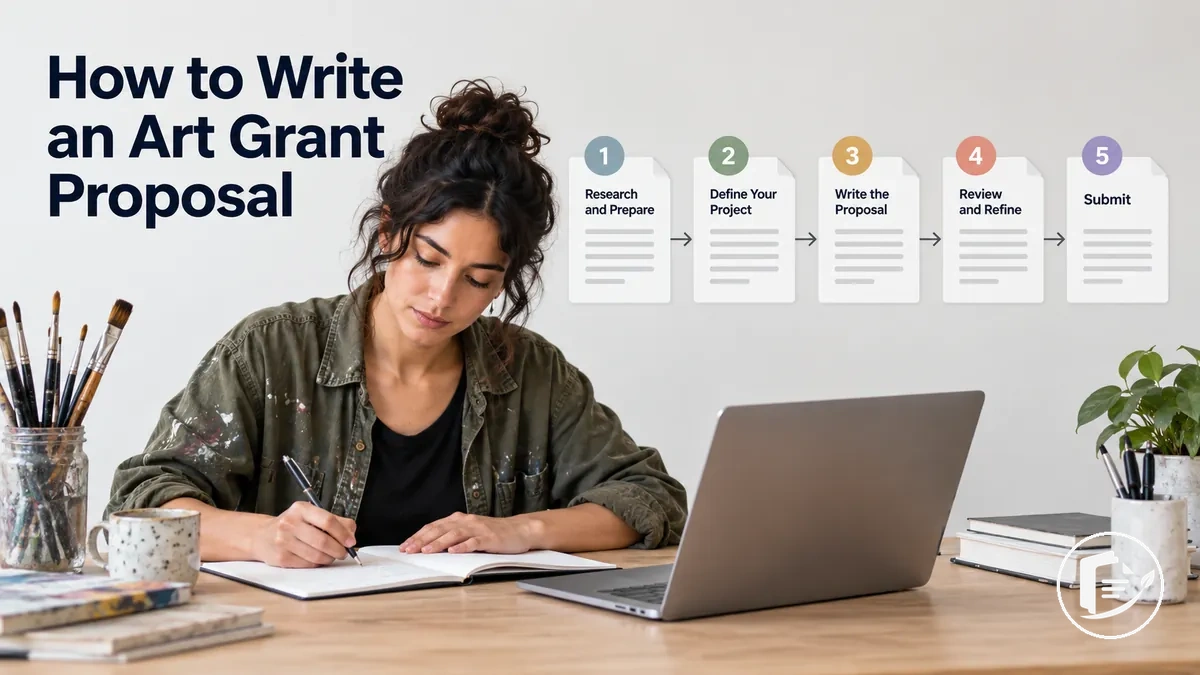
Art grant proposal logic at a glance
Build the proposal as one evidence chain. Application fields can appear in a different order, but these relationships should remain consistent.
- Requirements and project factsRecord the eligibility rules, criteria, and submission constraints; establish the project scope, resources, costs, dates, and other facts the application must represent.
- Purpose and artistic rationaleState what the project is intended to do and why the chosen artistic approach matters in its specific context.
- GoalsIdentify what the project aims to achieve so the proposed work has a clear direction.
- Methods and activitiesExplain how the work will be carried out and how each relevant activity supports the stated goals.
- Intended outcomesDescribe results that are plausible given the proposed work, qualifying outcomes that depend on audience or other external conditions.
- Criteria-based revisionMap each stated criterion or requirement to identifiable evidence in the draft and correct missing, ambiguous, or unsupported claims.
Keep constant: the same project scope, resources, costs, dates, participants, activities, and intended results should not change meaning across the application without explanation.
The exact application narrative depends on the funder: required fields, assessment criteria, word limits, supporting materials, and submission conditions can differ. There is no universal proposal format; use the funder's published requirements as the controlling constraints and keep the same verified project facts consistent throughout the application.
Table of Contents
Gather the Grant Requirements and Project Details
Preparation should begin by extracting the grant requirements and fixing the project details that the proposal must reflect.
Keep funder-imposed conditions separate from project-specific inputs so eligibility, assessment criteria, submission constraints, and the artistic project's actual scope can be verified before drafting.

Grant requirements may specify eligibility, assessment criteria, a word limit, required fields, supporting materials, and a submission deadline, so use the grant's published instructions as the controlling source for those conditions.
Assessment criteria also indicate which project evidence deserves emphasis when you tailor the proposal to the grant.
Before writing, verify the following grant constraints and project inputs rather than assuming that requirements are consistent across funders.
- Eligibility: confirm that the applicant and proposed artistic project satisfy the eligibility conditions stated by the funder.
- Assessment criteria: record each published criterion and identify the project information or evidence that can address it.
- Word limit and required fields: note the permitted length and required responses because these conditions constrain how much project information can be included.
- Supporting materials: identify only the documents, samples, statements, or other materials specifically requested for the application.
- Deadline and submission conditions: record the stated closing date, submission method, and any account, format, or file requirements listed by the funder.
- Project scope: fix what work will be undertaken, its intended outputs, and the boundaries of the proposed activity so the narrative does not describe a different project from the one being funded.
- Resources and dependencies: identify the people, facilities, permissions, partnerships, materials, or other conditions the project relies on where they affect feasibility.
- Project costs and dates: establish the costs and relevant project dates that the proposal must represent consistently, while keeping detailed budget construction and timeline development separate from this preparation step.
The project details should provide a stable factual base for the narrative: project scope identifies what is being proposed, resources identify what the work requires, dates establish when relevant activities are expected to occur, and dependencies identify conditions that could affect delivery.
Project costs are another required input, so establish the figures needed to build the grant budget without attempting to construct the full budget within this preparation stage.
These project inputs should remain consistent wherever the application refers to the same activity, resource, cost, or date.
For example, if a grant sets a particular word limit, that condition determines how much detail can fit in the relevant response; if an assessment criterion asks for evidence of project feasibility, preparation should identify the project facts that demonstrate feasibility before drafting begins.
Once the grant-imposed requirements and project-specific inputs have been verified, they can be organised into the proposal's core content without expanding this stage into budget writing, timeline development, work-sample selection, or full application tailoring.
Build the Art Grant Proposal Around Its Core Sections
The core sections of an art grant proposal function as distinct parts of one proposal argument rather than as disconnected form fields.
Each component carries a different information function, while the proposal narrative connects those functions through the same artistic project and project logic.

The project purpose and artistic rationale establish what the project is intended to do and why its artistic approach matters in context.
Goals and intended outcomes identify what the project aims to achieve, while methods and project activities explain how the proposed work will be carried out.
These core sections contribute different information functions to the proposal narrative, but they remain connected because the activities should support the stated goals and the intended outcomes should remain consistent with the project purpose.
- Project purpose and artistic rationale: establishes the project's purpose and explains why the proposed artistic approach matters within its context.
- Goals and intended outcomes: identifies what the project aims to achieve and the results it intends to produce.
- Methods and project activities: explains how the proposed work will be undertaken and how the activities support the project's goals.
Application forms may request related information in separate documents, so those documents should remain consistent with the project-focused proposal without being treated as additional core sections of its argument.
For example, a funder may separately ask an applicant to write the artist statement; that document can address the artist and their practice while the proposal's artistic rationale remains focused on the proposed project.
The proposal should remain one connected whole even when supporting information is supplied elsewhere in the application.
Project Purpose and Artistic Rationale
The project purpose states what the artistic project is trying to do, while the artistic rationale explains why the proposed work and its artistic approach matter in context.
Keeping these functions distinct helps the proposal connect a concrete project aim with a project-specific reason for undertaking it.
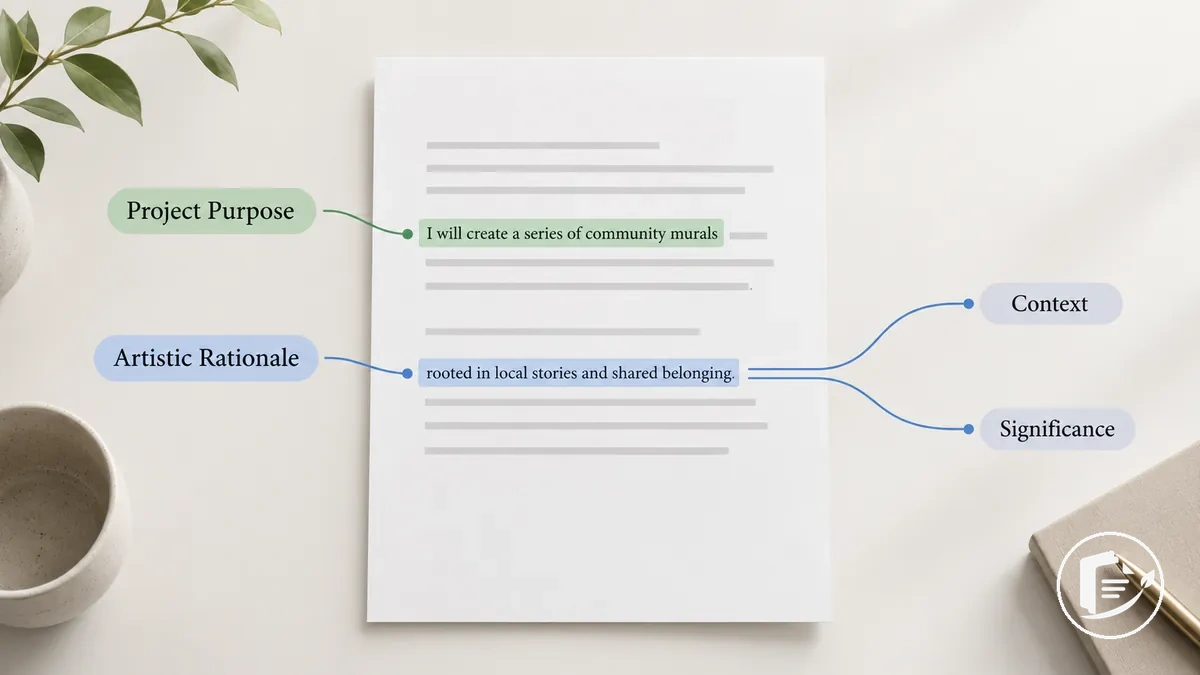
The artistic project should remain the subject of both components: the project purpose identifies the intended work or contribution, while the artistic rationale connects the chosen artistic approach to the context and significance relevant to that work.
A significance claim is more credible when it identifies the specific context that gives the proposed work relevance rather than relying on broad claims about artistic importance.
When you write the project description, the fuller description can explain what the project involves, while the artistic rationale remains focused on why this work and approach matter within the stated context.
For example, “This project will create meaningful art about community” gives little information about either the work or its rationale.
A more specific statement such as “This project will create a mixed-media installation using recorded local migration stories to examine how personal memories contribute to a community's understanding of place” names the proposed work, identifies the artistic approach and context, and makes the claimed significance specific to the artistic project rather than to the artist's broader identity.
Goals and Intended Outcomes
Project goals state what the artistic project aims to achieve, while intended outcomes describe the observable or defensible results associated with pursuing those goals.
A project output is something the project can directly produce or complete, whereas a broader outcome may depend on the audience, context, or other external conditions.
This distinction separates what the artistic project can directly produce from results that may depend on conditions beyond project completion.
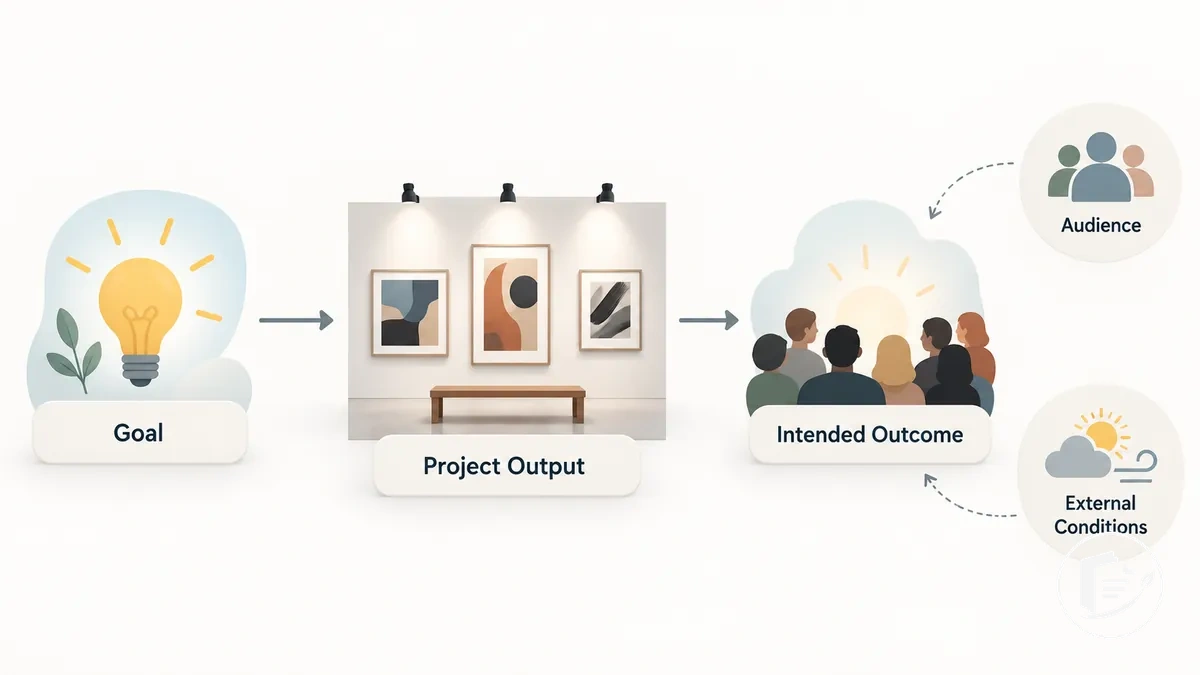
Each goal should connect to a plausible intended outcome and to evidence, an activity, or a completion state that makes the relationship credible.
For example, a goal to develop and present a new body of work can produce a completed exhibition as the project output; an intended outcome such as deeper audience engagement may be supported by the exhibition but cannot be treated as certain because audience response depends on conditions beyond project completion.
Where a grant's assessment criteria call for measurable results, use evidence the project can actually generate—such as a completed deliverable, documented participation, or feedback where it is collected—rather than inventing a fixed metric.
Methods and Project Activities
Project methods explain how the artistic project will be carried out, while project activities name the concrete work performed to advance its goals.
A method describes the approach used to perform an activity; each activity should make a clear contribution to the stated goal rather than simply naming a broad intention.
Activities should identify the resources, dependency, or condition that materially affects execution and show how the chosen method contributes to the project.
A sequence is useful only when one activity requires another to happen first; activities that can occur independently do not need to be presented as chronological steps.
Making these relationships explicit helps an assessor judge whether the proposed scope and resources support the project's feasibility.
The image visualises how specific project activities connect with their methods and goals, including a dependency only where one action must precede another.
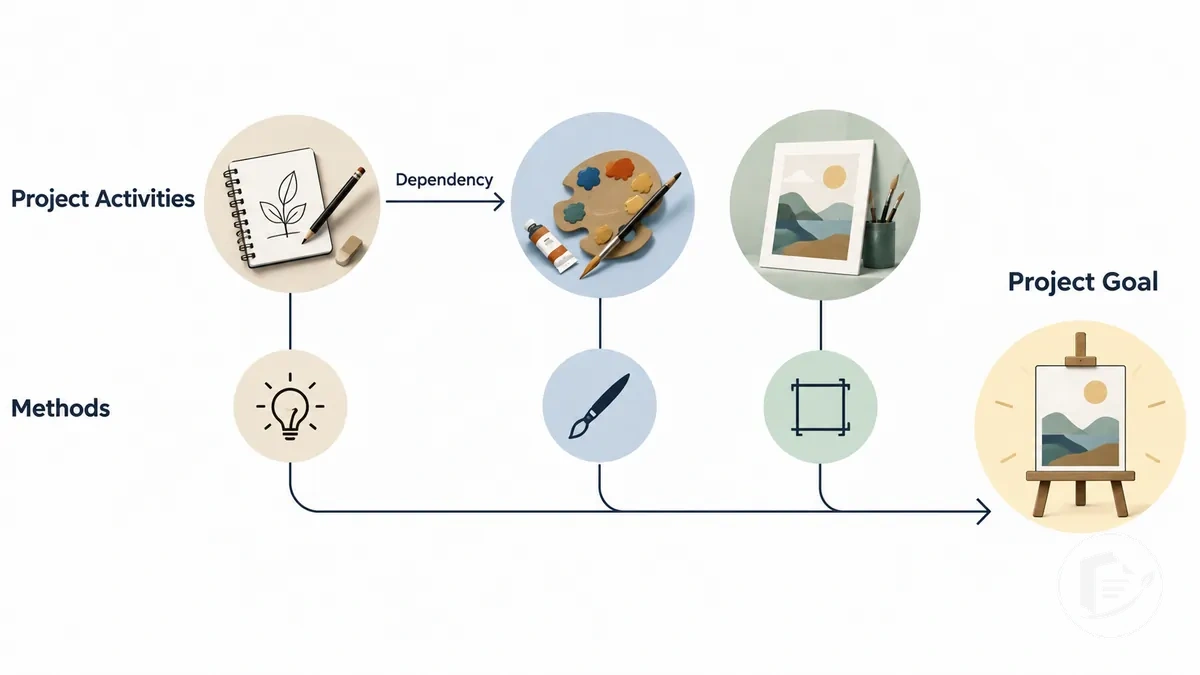
For example, “work on the exhibition” is too vague to show how the work will be performed, while an illustrative activity such as “record participant interviews, then use selected material to develop the exhibition works” identifies a method, a genuine dependency, and a contribution to the exhibition goal.
Where activities do have a meaningful order, that sequence can later be used to create the project timeline as dated milestones without expanding this section into timeline construction.
Connect the Sections Into a Coherent Proposal Narrative
A coherent proposal narrative carries the same project logic across its sections while each section adds new information rather than repeating identical wording.
Three continuity checks
- Stable project identity
- Use consistent terms for the same project, participants, activities, resources, and intended results so they do not appear to become different subjects.
- Information progression
- Let each section add a distinct claim while preserving facts already established instead of repeating or silently changing them.
- Supported connections
- Purpose constrains the relevant goals, goals guide the methods, and the described work provides the basis for plausible intended outcomes.
For example, fragmented wording might describe a project purpose as creating an exhibition about local migration stories, later introduce a goal about community storytelling without connecting it to the exhibition, and then name interviews as a method without explaining their contribution.
Connected wording keeps the relationship explicit: the project creates an exhibition about local migration stories, the goal is to represent those stories through the exhibition, and interviews provide source material that supports the works developed for it.
Reviewing complete artist grant application examples can help you observe how proposal parts maintain this consistency in practice without replacing the need to establish the logic in your own application.
Each section should therefore add a distinct claim while preserving the same project identity and continuity established by the sections before it.
Order the Narrative From Purpose to Execution and Outcomes
The proposal narrative should follow a logical progression from purpose and rationale to goals, execution, and intended outcomes.
This sequence describes the reasoning that connects the proposal's claims, not the order in which every funder presents its application fields.
The four stages below show what should already be established, what each stage adds, and how that information supports what follows.
When a funder's form uses a different order, the same logical progression can still connect the information across its required fields.
- Establish the purpose and rationale. Clarify what the artistic project is and why it matters so the proposal has a defined foundation. That foundation leads into goals that remain connected to the project's stated purpose.
- State the goals. With the purpose already clear, identify what the project intends to achieve. These goals provide direction for the methods and activities used during execution.
- Explain the methods and activities. With the goals established, show how the proposed execution supports them and clarify relevant feasibility. This execution logic provides the basis for understanding why the stated outcomes are plausible.
- State the intended outcomes. With the purpose, goals, methods, and activities already established, describe the intended results in relation to that preceding logic. The outcomes should follow from the proposal's progression rather than appear as unsupported claims.
For example, if a funder's form requests outcomes before methods, the outcomes can still refer to the same goals that the later methods and activities support.
The visible order changes, but logical continuity remains when each field connects consistently to the same project purpose, goals, execution, and outcomes.
Keep Goals, Methods, and Outcomes Aligned
Goal-method-outcome alignment means each goal is supported by a credible method or activity, and each intended outcome is plausible given that work. Alignment does not require a rigid one-to-one formula.
Check each chain by testing the relationships below.
Alignment decision rules
- If a goal lacks supporting work
- Add or revise a method or activity so the proposal shows how the project can credibly advance that goal.
- If an activity supports no stated goal
- Connect it to a relevant goal, revise its role, or remove it if it does not contribute to the proposed project logic.
- If one method supports several goals
- That is acceptable when each connection is clear; separate methods are not required merely to create a one-to-one match.
- If an intended outcome lacks credible support
- Add relevant support, narrow the claim, or revise the outcome so it remains plausible given the proposed methods and activities.
- If an outcome depends on audience or external conditions
- Qualify the outcome rather than treating it as certain. State it as an intended result supported by the work, not a guaranteed effect.
For example, a goal to develop an exhibition reveals a gap if the stated activities cover only audience promotion while the intended outcome assumes that the exhibition will be completed.
The smallest correction is to add the missing development activity or revise the intended outcome so the goal, method, activity, and intended outcome form a consistent, plausible chain.
The alignment check is complete when the proposal's relationships are logically consistent, not when they conform to a rigid matching formula.
Revise the Proposal Against the Grant Criteria
Revise a completed draft by comparing its content directly with the grant criteria and application requirements.
Each stated criterion or requirement should map to clear evidence in the draft; where that evidence is missing, ambiguous, inconsistent, or unsupported, identify the gap and make a specific revision action rather than adding more persuasive language.
Use the verification checklist as an audit of the existing draft, not as a new planning workflow.
For each item, identify the relevant criterion or requirement, locate the evidence that addresses it, and correct any gap or ambiguity before submission.
- Grant criteria: Check that every stated assessment criterion is addressed by identifiable evidence in the draft; if a criterion is unsupported or unclear, add or clarify the relevant project information.
- Application requirements: Check required questions, fields, and requested information against the completed draft; if required information is absent, revise the appropriate response rather than assuming another section covers it.
- Feasibility: Where feasibility is a stated criterion, check whether the draft identifies the relevant method, resource, or constraint that supports the proposed work; clarify whichever element is missing or ambiguous.
- Supporting materials: Check that required supporting material is present and corresponds to the application requirements; if material is missing or does not meet a stated requirement, correct it before submission.
- Word limit: Check each response against the word limit stated by the grant; if a response exceeds it, remove repetition or lower-priority detail while preserving evidence needed for the relevant criterion.
- Consistency: Check that project facts, methods, resources, and intended results remain consistent across the draft; revise contradictions or unexplained changes in terminology that create ambiguity.
- Unsupported claims: Check whether each material claim is supported by project facts or appropriate evidence; qualify, substantiate, or remove claims that the draft cannot support.
- Final clarity: Check whether an assessor can identify the evidence relevant to each stated criterion without having to infer the connection; clarify the relationship where the evidence is present but its significance is ambiguous.
Gaps can also occur outside the main narrative when required supporting materials do not match what the application asks for, so verify those materials against the stated requirements rather than treating their presence alone as sufficient.
Where work samples are required, verify that you choose grant work samples that satisfy the application requirements without using proposal text to compensate for missing material.
Resolve remaining ambiguities while preserving consistency and factual accuracy across the completed draft.
For example, if feasibility is a stated criterion and the draft names an ambitious activity without explaining the method, available resource, or relevant constraint, revise that passage to make the supporting project fact explicit.
The final revision pass should leave the proposal clear and factually coherent within the grant's requirements, without strengthening claims beyond the available evidence.
Common Art Grant Proposal Writing Mistakes
The most consequential art grant proposal writing mistakes weaken clarity, logical alignment, evidence, or responsiveness to the grant criteria.
Problems such as a vague purpose, misaligned goals and methods, unsupported outcomes, and generic language can obscure what the project will do and whether the proposal supports its own claims.
The grouped mistakes below connect each writing problem to its consequence, a recognition cue, and a corrective direction.
Use the cues to identify weaknesses in the proposal logic, then correct the underlying information rather than relying on surface polish.
- Vague purpose: A vague purpose obscures the specific project and its rationale. If the purpose could describe many unrelated projects, correct it by clarifying the proposed work, its relevant context, and what the project is intended to accomplish.
- Failure to respond to grant criteria: A proposal can contain substantial project information while leaving a stated criterion unanswered. If the evidence relevant to a criterion is missing or difficult to identify, correct it by making that evidence explicit and directly connected to the applicable criterion.
- Misaligned goals and methods: A mismatch creates a gap between what the project intends to achieve and what its methods or activities actually support. If a stated goal has no credible connection to the proposed work, correct the mismatch by revising the method, activity, or goal so the relationship is explicit.
- Unsupported outcomes: An intended outcome is left unsupported when the proposal states a result that is not plausible given the described work or relevant conditions. Recognize this when the draft moves from an activity to a broader result without explaining the support between them; correct by adding relevant evidence, narrowing the claim, or qualifying outcomes that depend on external conditions.
- Inconsistent project claims: Contradictory descriptions of scope, resources, activities, or intended results weaken internal consistency. If the same project element changes meaning across the proposal without explanation, correct by reconciling the conflicting claims and using stable terminology.
- Generic language: Generic language weakens specificity when broad claims replace concrete project information. If phrases about impact, quality, or importance could be transferred to another proposal without changing their meaning, correct by replacing them with project-specific facts, actions, conditions, or evidence.
For example, “This project will make an important contribution to the community” leaves the purpose and contribution unclear; a more specific correction identifies the artistic work, the relevant community context, and the intended contribution without assuming an audience response.
Likewise, an outcome such as “the exhibition will increase audience understanding” is unsupported when the proposal provides no basis for that effect; a correction can state that the exhibition is intended to support audience understanding while acknowledging that the response depends on audience and contextual conditions.
Correcting these proposal mistakes means repairing unclear or unsupported relationships among the project's claims, not simply making the language sound more polished.
The final draft should remain specific, internally consistent, evidence-bounded, and responsive to the stated grant criteria.